

ADHD is usually described from the outside: difficulty concentrating, losing things, forgetfulness, restlessness, impulsivity and trouble finishing tasks.
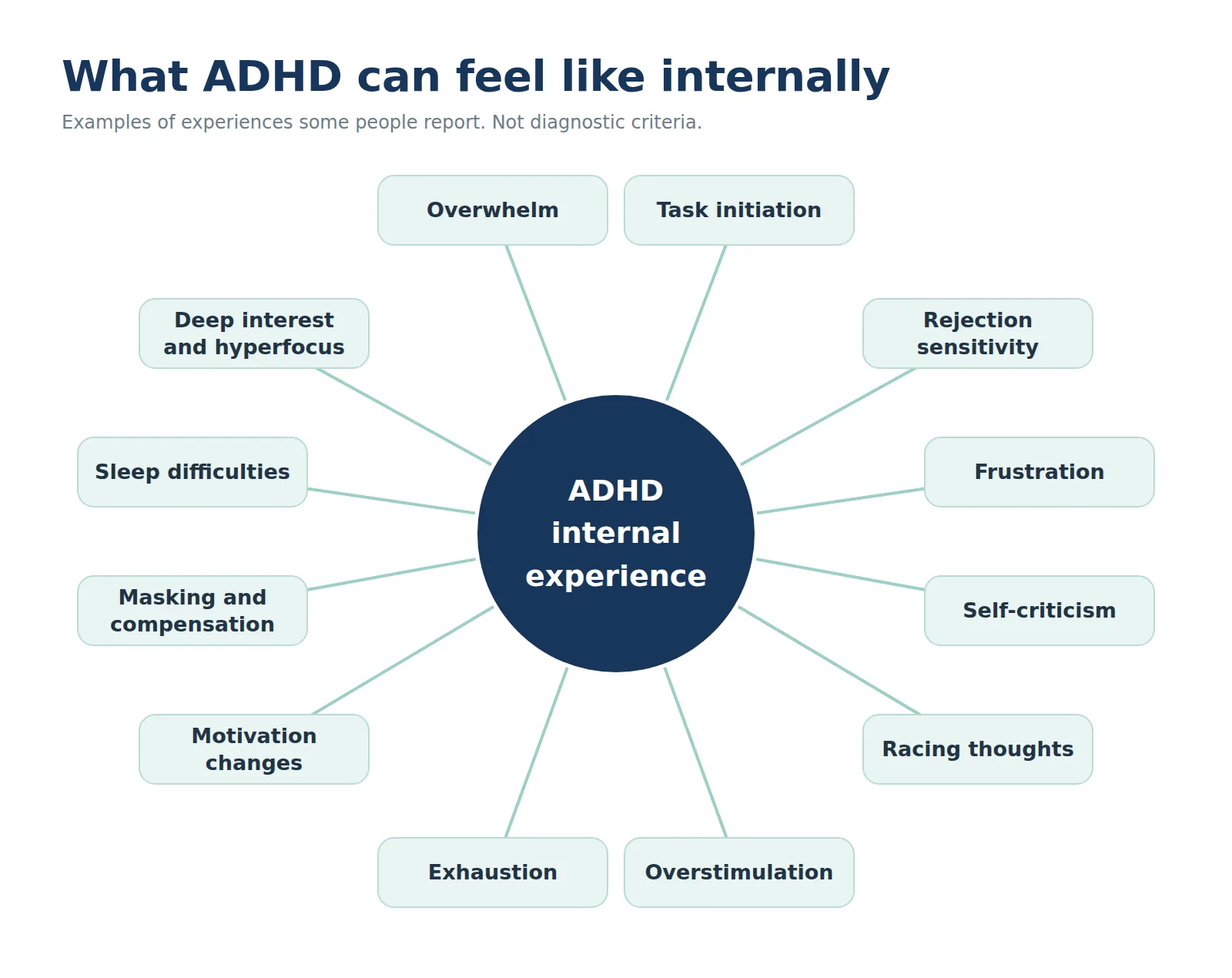
That list does not always explain what living with ADHD can feel like on the inside. For some adults there is another layer. Knowing exactly what needs to be done and being unable to start. Feeling overwhelmed by tasks that look simple to everyone else. Taking criticism deeply. Being intensely interested in something, then suddenly struggling to engage with it. Holding everything together in public and feeling completely drained at home.
ADHD is a neurodevelopmental condition, described clinically as persistent patterns of inattention and/or hyperactivity and impulsivity that begin in childhood. In adults it can show up differently, and it can get in the way of work, relationships, organisation, sleep and everyday life.
Emotional dysregulation is not currently one of the formal diagnostic criteria for ADHD, and not everyone with ADHD experiences it the same way. Research and clinical guidance still treat difficulty regulating emotions as important for many adults with ADHD.
This is not a list of things every person with ADHD feels. It is a guide to experiences some people with ADHD recognise, and to the questions they may quietly ask themselves.
Key takeaways
- ADHD can affect more than attention. Executive functioning, motivation, emotional regulation, relationships, sleep and everyday routines may all be affected.
- Overwhelm, shame, rejection sensitivity, frustration and exhaustion are not exclusive to ADHD. Feeling them is not proof that someone has ADHD.
- Emotional dysregulation is frequently reported in ADHD, but it is not currently a formal core diagnostic criterion.
- ADHD experiences vary a lot. Two people with the same diagnosis can live very different days.
- Significant depression, anxiety, big mood changes, ongoing sleep problems or safety concerns deserve a professional assessment rather than being put down to ADHD.
ADHD is not simply being distracted
One reason ADHD is so often misunderstood is that people see the outcome without seeing the effort behind it.
- They see someone who is late. They may not see the hour spent trying to get out of the house.
- They see an unfinished report. They may not see the hours spent thinking about starting it.
- They see someone interrupt. They may not see the instant regret afterwards.
- They see someone scrolling on their phone. They may not see a person who is mentally exhausted and cannot decide what to do next.
That gap between what people see and what someone goes through inside can become one of the hardest parts of ADHD.
1. "I know what I need to do. Why can't I just start?"
You have answered the emails in your head six times. The washing needs folding. The presentation is due tomorrow. The appointment needs booking. None of it is complicated, and yet you sit there.
People often call this ADHD paralysis or task paralysis. It is not a formal diagnosis, but it describes something many people with ADHD recognise: difficulty turning intention into action. What looks like procrastination from the outside can involve difficulty with starting a task, prioritising, organising and keeping the effort going.
The internal thought can shift quickly from "I need to start" to "Why haven't I started?" to "What is wrong with me?" That last question is where an executive function problem can start turning into a self-esteem problem.
If this one is familiar, the Dopamine Menu is a simple tool some people use to get moving when they are stuck.
2. "Why does everything suddenly feel like too much?"
One unfinished job is manageable. Then an email arrives. The phone rings. Someone asks a question. Another notification. The kitchen needs cleaning. You remember something you forgot yesterday.
Suddenly the problem is not any single task. It is all of them at once. For some people with ADHD, overwhelm arrives when demands compete for attention faster than they can be sorted, prioritised or acted on.
Instead of "Which one should I do?" the internal response becomes "I can't deal with any of this." That matters, because adding more instructions to an already overloaded person can make things worse rather than better.
3. "Why did that small comment hurt so much?"
Your manager says, "Can we change this?" Your partner replies differently than usual. Someone takes longer to answer a message.
Logically, you may know there are dozens of possible explanations. Emotionally, the interpretation can arrive instantly: "They're disappointed in me." "I've done something wrong." "They don't like me anymore."
Rejection sensitivity is getting more research attention in ADHD. The popular term rejection sensitive dysphoria, or RSD, is not an official psychiatric diagnosis, and the evidence for it as a distinct ADHD feature is still developing. A small 2026 study of five university students with ADHD described rejection sensitivity bringing on unpleasant bodily sensations, anxiety and withdrawal. A critical review published the same year warned that framing RSD as fixed and innate can add to stigma and draw attention away from what is happening around a person.
None of that makes somebody's experience of rejection imaginary. It means describing the experience accurately without making the evidence say more than it does. Our complete guide to rejection sensitive dysphoria goes into it in more depth.
4. "Why did I react so strongly?"
Sometimes the emotion seems to arrive before the reasoning does. A frustrating email becomes anger. A mistake becomes humiliation. A disagreement feels enormous. A disappointing conversation takes up your attention for hours.
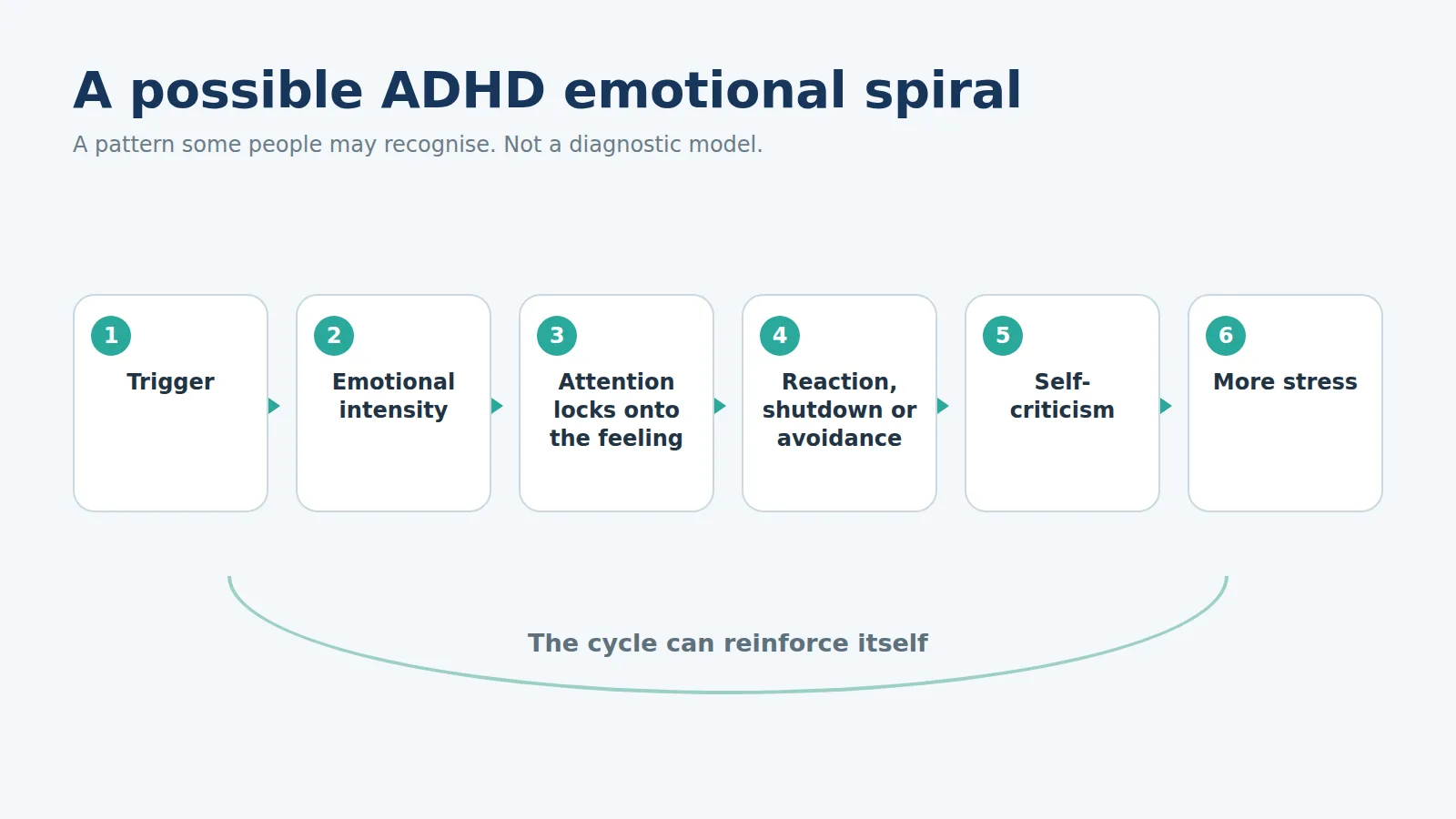
Adults with ADHD often report difficulty regulating or redirecting an emotional response once it has started. That can create a second problem on top of the first. The first emotion may be anger. The second is "I can't believe I reacted like that." Then come embarrassment, self-criticism and rumination.
Understanding that sequence tends to be more useful than being told to calm down.
5. "Why do I feel so ashamed about things that seem easy for everyone else?"
A forgotten appointment. An unpaid bill. Another late arrival. Another half-finished project. Another promise to yourself that tomorrow will be different.
The danger is when "I forgot something" becomes "I'm unreliable", "I struggled to start" becomes "I'm lazy", or "I made a mistake" becomes "I'm a failure".
The difference between behaviour and identity matters. A difficulty with executive functioning describes something that happened. Shame turns it into a statement about who you are.
That is one reason ADHD conversations need to go beyond productivity hacks. Calendars, reminders and systems can help, but years of criticism can leave patterns of self-judgement that stay put even after someone understands their ADHD better.
6. "Why does everyone else seem to cope better than me?"
Other people seem to answer messages, remember birthdays, pay bills, keep the kitchen tidy, arrive on time and keep up friendships.
You see their outcome. You experience your own effort. Those are not equal comparisons. When ordinary responsibilities keep taking far more organisation and mental effort, a person can start using everyone else's visible performance as evidence against themselves.
A more useful question is: "What makes this particular task hard for me, and what would make it easier?" That moves the conversation from judgement to problem solving.
7. "I hold it together all day. Why do I fall apart when I get home?"
You get through the meeting. You remember not to interrupt. You check your work again and again. You force yourself to stay organised. You watch whether you are talking too much. You cope.
Then you get home and feel as if somebody has pulled the plug.
This is one of the experiences often talked about as ADHD masking or camouflaging. Research in this area is still developing, so it should not be presented as settled science. Plenty of people recognise the experience of hiding difficulties or compensating hard all day, and it does not need to become another diagnostic label to be worth taking seriously. ADHD in women is where this comes up most often.
8. "Why do I suddenly need everyone to leave me alone?"
Sometimes the problem is not another thought. It is another sound. Another person talking. A television in the background. Somebody chewing. A child asking a question while the phone rings. A busy supermarket, bright lights, several conversations at once.
Sensory processing differences, including sensory sensitivity and sensory avoidance, are being studied more in ADHD. That does not mean every irritation is ADHD. For some people, cutting down competing sensory input makes it easier to think, respond and settle. If sounds like chewing or breathing are the trigger, our article on misophonia and ADHD in women may be useful.
9. "Why won't my brain shut up?"
You get into bed. The house finally goes quiet. And your mind schedules a meeting with every thought you did not get to during the day.
Something you said six hours ago. Tomorrow's jobs. A bill. An idea. Something embarrassing from 2008. The thing you forgot to look up.
Not every racing mind is ADHD. Anxiety, stress, sleep disorders, medication effects and other conditions can all play a part. Sleep does deserve particular attention in adult ADHD, because the pieces can feed each other: racing thoughts at night, putting off bed, waking tired, and then finding emotions harder to manage the next day.
10. "I'm exhausted. Why am I still avoiding bedtime?"
You are tired. You know tomorrow will be worse if you stay up. And yet midnight arrives and you are still scrolling, watching or reading something that could easily wait until tomorrow.
The internet calls this revenge bedtime procrastination. The phrase describes a behaviour, not an ADHD symptom. For some people, late evening feels like the first time all day that nobody wants anything from them. For others, moving away from something engaging is hard. Others simply lose track of time.
A more useful question can be: "What keeps happening between knowing I should go to bed and actually going?"
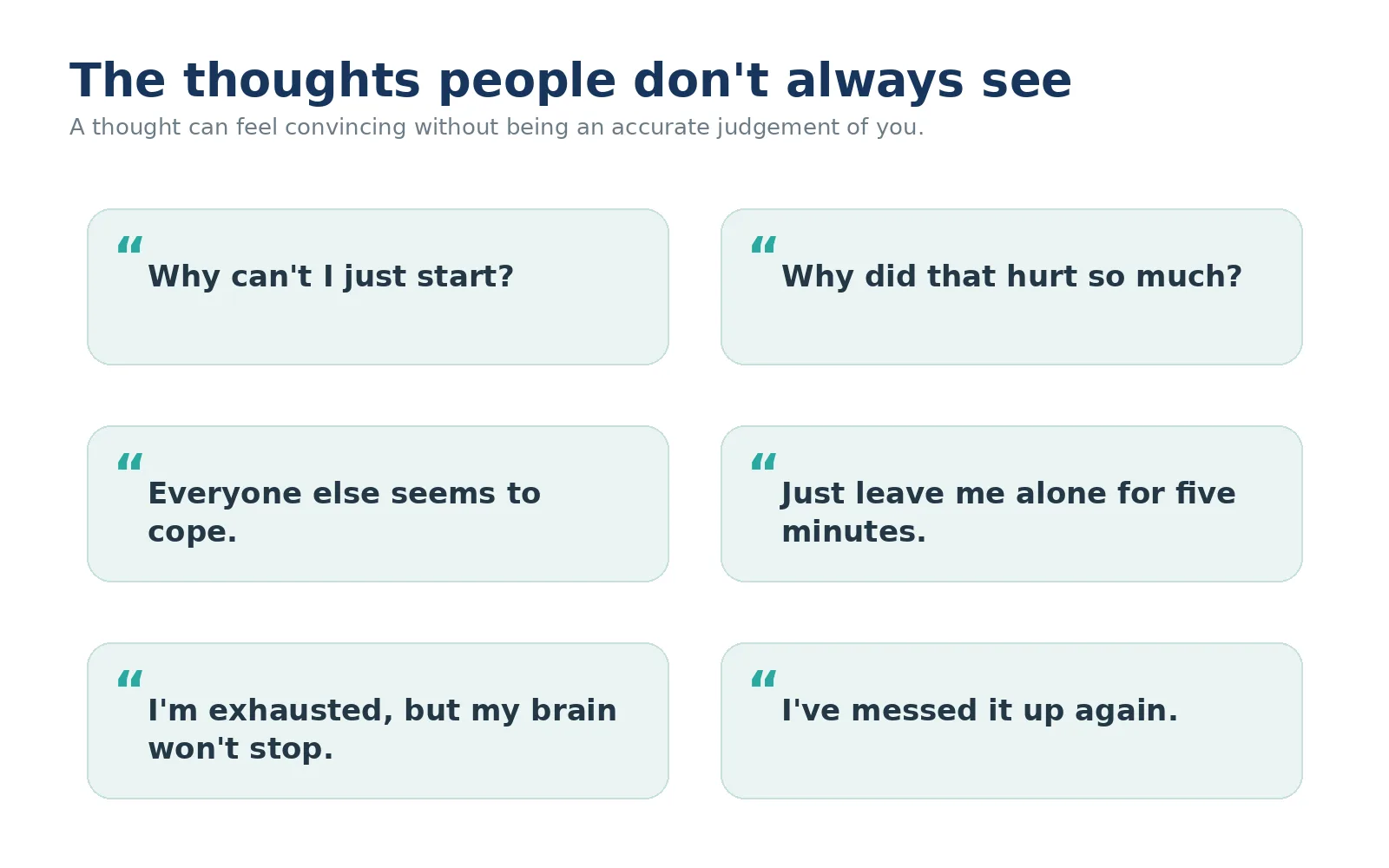
11. "Why can I focus on one thing for hours but struggle with something that takes ten minutes?"
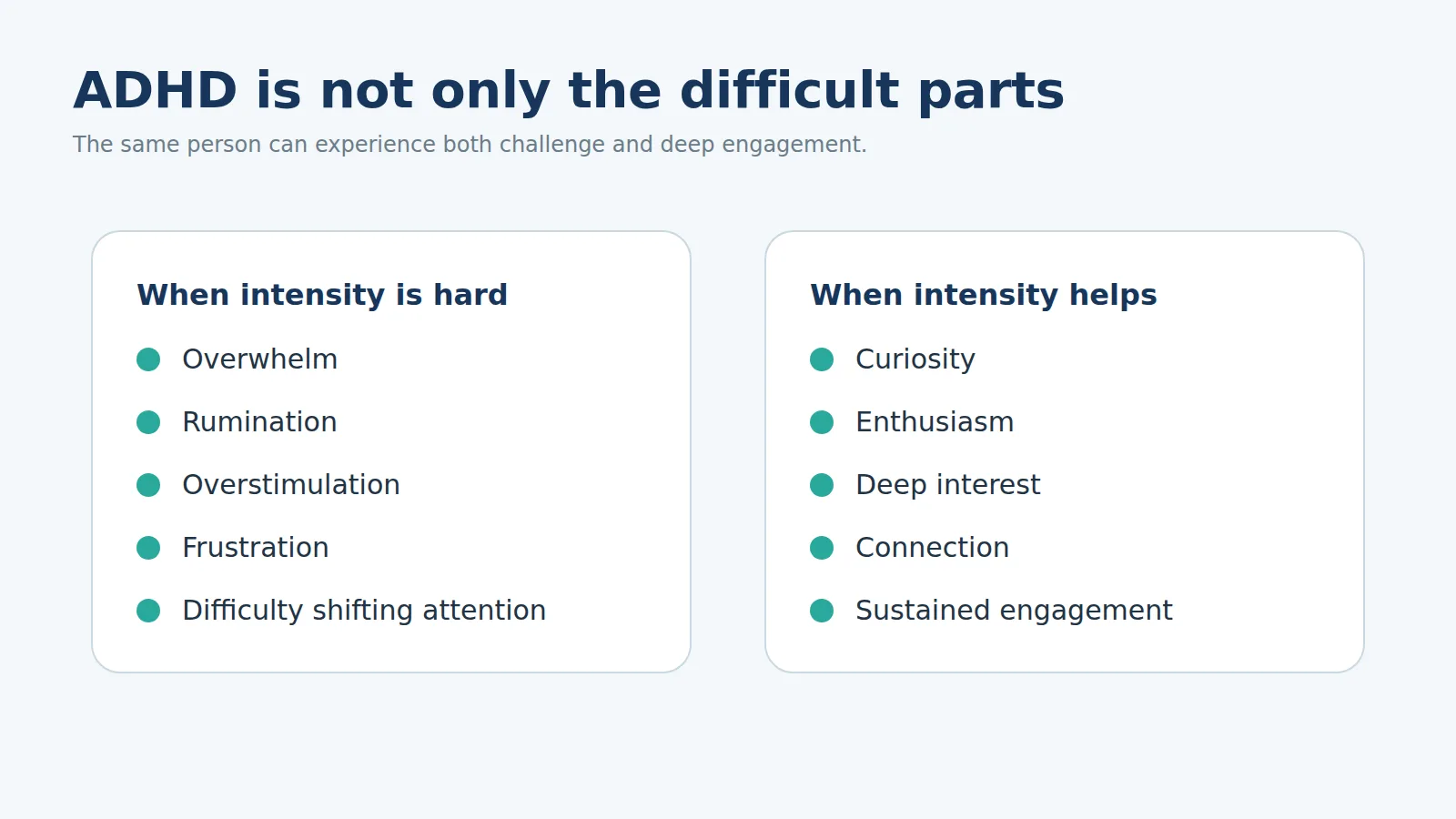
This apparent contradiction causes a lot of confusion. ADHD is not simply an absence of attention. Attention can be hard to regulate.
Something new, urgent, challenging or personally interesting can grab attention strongly, while an important but less stimulating task stays extraordinarily hard to start or keep going with. From the outside it looks inconsistent. From the inside it can feel inconsistent too, and that becomes one more thing to criticise yourself for.
12. "Why am I motivated one day and completely stuck the next?"
A good day can bring false confidence: tomorrow I'll clean everything, answer every email, exercise, plan meals and start the project. Then tomorrow arrives, and the mental energy that made the plan feel obvious has gone.
The answer is not necessarily to want it more. One useful approach is to make important actions depend less on how motivated you feel at the time:
- reminders that live outside your head
- smaller starting points
- visible prompts
- fewer choices
- routines decided in advance
The Dopamine Menu is one way to set this up. It is a practical tool, not a claim that ADHD comes down to low dopamine, which is a much bigger simplification than the research supports.
13. "Why am I so tired when I haven't even done that much?"
Mental effort is still effort. Trying to remember what you are forgetting. Pulling your attention back to a task again and again. Double-checking yourself. Keeping track of time. Holding back the urge to interrupt. Trying not to lose something. Trying to look organised. None of it is particularly visible.
Exhaustion should still be looked into rather than put down to ADHD. Poor sleep, depression, anxiety, physical health problems, medication effects and plenty of other things cause fatigue. If you are tired all the time, or it is new or getting worse, see your GP. Our article on why sleep isn't fixing your exhaustion covers the medical causes worth ruling out.
14. "Why do I keep replaying what I said?"
You interrupt someone. You talk for longer than you meant to. You forget a detail they told you. You answer too quickly. Later, you realise how something sounded.
Then the conversation ends, but not in your head. You replay it, edit it, imagine how you should have answered and wonder what they thought.
There is an important difference between reflecting on a mistake and turning it into evidence that you are fundamentally bad at relationships. One allows change. The other builds shame.
15. "Is ADHD only about the difficult parts?"
No, and an article like this should not leave that impression by accident.
Some people with ADHD describe intense curiosity, enthusiasm, humour, fast-moving ideas, deep interest, spontaneity, strong emotional connection and long stretches of concentration on things that matter to them.
None of that should be romanticised as universal ADHD superpowers. It is part of the wider point: a person is much more than a diagnostic label. The goal is not to split ADHD into a list of flaws and strengths. It is to understand how this particular person works, what gets in their way, what supports them and what matters to them.
ADHD mood swings are not automatically ADHD
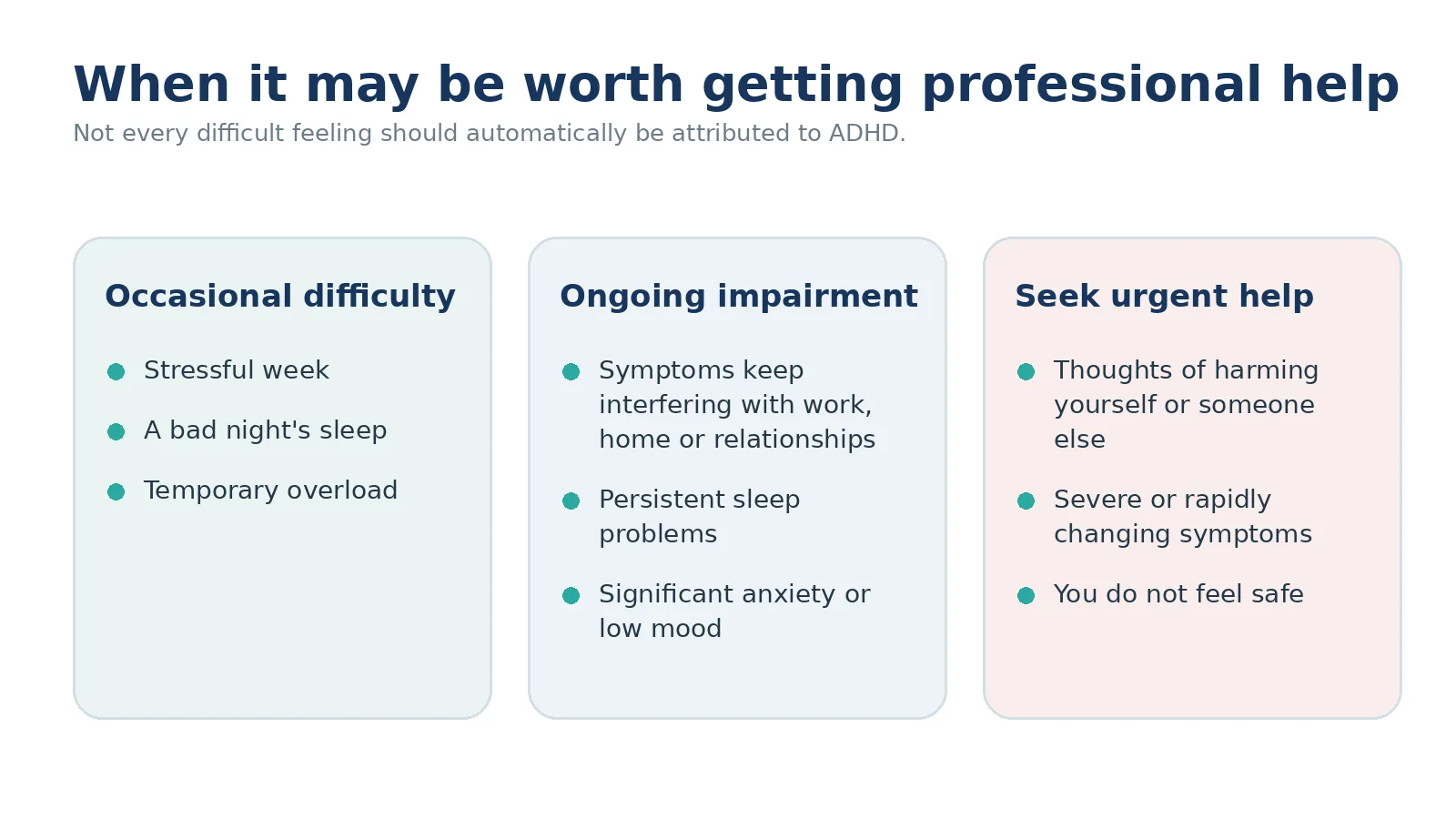
Some people use the phrase ADHD mood swings to describe fast emotional reactions. Significant changes in mood can also come with anxiety, depression, bipolar disorder, trauma, sleep problems and many other physical or psychological conditions.
ADHD should not become a handy explanation for everything someone feels. A proper assessment looks at developmental history, symptoms across different settings, how much they get in the way, and other possible explanations. In Australia that usually starts with your GP, who can refer you to a psychiatrist or, for younger people, a paediatrician.
Get professional help rather than assuming ADHD is the explanation if your mood has changed a lot, stays low or unusually high, is getting in the way of daily life, or comes with thoughts of harming yourself or someone else.
If you are thinking about harming yourself or someone else, or you do not feel safe, call 000 now. Lifeline is on 13 11 14, any time of day or night.
What can actually help when ADHD starts to feel overwhelming?
There is no single technique that suits everyone. A useful first step is often separating the problem from the judgement about the problem.
- "I can't start this task yet" gives you something to work with. "I'm lazy" does not.
- "I reacted much more strongly than I wanted to" is information. "I'm impossible" is condemnation.
Then look at what is around you:
- Can the task be made smaller?
- Can competing noise and input be cut down?
- Does the reminder need to live outside your head?
- Are you exhausted?
- Could a difficult reply wait ten minutes before you send it?
- Do you need clinical support rather than another productivity technique?
For adults diagnosed with ADHD, evidence-based care can include medication and non-medication support, and Australia has its own national clinical guideline for it, listed below. That care belongs with your GP, psychiatrist or psychologist.
Where MindShift fits is smaller and more specific. Our sessions use Cognitive Pattern Reprogramming, the method created by our co-founder Rob Edmonds, who holds diplomas in Clinical Hypnosis and Strategic Psychotherapy and is a Neuro-Linguistic Programming Master Practitioner. Cognitive Pattern Reprogramming is not hypnosis. It uses a structured psychological framework aimed at the automatic response, delivered as guided audio. You stay aware and in control the whole way through, and it is designed to sit alongside anything else you already use.
It does not diagnose or treat ADHD, and it is not a replacement for medical, psychological or psychiatric care. It is aimed at the patterns that can build up around ADHD, like the self-criticism spiral after a strong reaction or the replaying at night. Many people find it easier to work on one of those patterns than to try to fix everything at once. Results vary. If you want the wider picture, the Focus, ADHD and Mental Performance pathway brings the related sessions together.
Understanding the pattern is different from blaming yourself
Perhaps the most important shift is this: a difficult pattern is something to understand. It is not a verdict on your character.
- There is a difference between "I forgot" and "I'm hopeless".
- There is a difference between "I got overwhelmed" and "I can't cope with anything".
- There is a difference between "I reacted too quickly" and "I ruin everything".
The first statement describes an event. The second creates an identity.
Understanding ADHD does not mean taking away responsibility for what you do. It can mean swapping "What is wrong with me?" for a better question: "What happened here, what pattern keeps repeating, and what could help me respond differently next time?"
Sources and further reading
This article describes lived experience, research findings and formal diagnostic criteria, and tries to keep the three separate. It does not diagnose ADHD and does not replace medical, psychological or psychiatric care. Last reviewed 24 September 2026.
- Australian Evidence-Based Clinical Practice Guideline for ADHD, Australian ADHD Professionals Association, 2022, endorsed by the National Health and Medical Research Council
- Attention deficit hyperactivity disorder: diagnosis and management (NG87), National Institute for Health and Care Excellence, United Kingdom
- Data on ADHD in Adults, Centers for Disease Control and Prevention, United States
- Adult ADHD and Emotions, CHADD
- Rowney-Smith A, Sutton B, Quadt L, Eccles JA. The lived experience of rejection sensitivity in ADHD: a qualitative exploration. PLOS One, 2026. A focus group study of five participants.
- Rejection sensitivity dysphoria: a critical reflection, 2026. Published in Dutch; English abstract on PubMed.
More on ADHD from MindShift Mentors: what ADHD is, its symptoms, types and causes, ADHD in adult men, ADHD, autism and AuDHD, and who we are.
Frequently Asked Questions
Emotional dysregulation is frequently reported by people with ADHD and is widely studied, but it is not currently one of the core formal diagnostic criteria for ADHD. Clinicians still treat it as important, because it can affect work, relationships and wellbeing.
ADHD can come with fast emotional reactions and difficulty regulating emotions for some people. Persistent or large changes in mood have many possible causes, including anxiety, depression, bipolar disorder and sleep problems, so they should be assessed by a professional rather than put down to ADHD.
Rejection sensitive dysphoria, or RSD, is not an official standalone psychiatric diagnosis. Rejection sensitivity is a genuine area of research, including early work involving ADHD, but the evidence is still small and RSD should not be presented as an established ADHD condition.
Sensory processing differences, including sensitivity to noise and a tendency to avoid busy environments, have been reported in ADHD research. Sensory problems can happen for many reasons, so feeling overwhelmed by noise is not proof of ADHD on its own.
ADHD involves difficulty regulating attention rather than having no ability to pay attention. Focus can vary a lot depending on interest, urgency, novelty and competing demands, which is why a person with ADHD may concentrate for hours on one thing and struggle to start another.
Sleep difficulties are common in adults with ADHD and can interact with daytime functioning and emotional regulation. Ongoing sleep problems have other possible causes as well, so they are worth raising with a GP.
Feeling overwhelmed, ashamed, rejected or exhausted does not on its own mean you have ADHD, because many people without ADHD feel these things too. An ADHD diagnosis needs a proper assessment of developmental history, day-to-day impact and other possible explanations. In Australia that usually starts with your GP.
Cognitive Pattern Reprogramming is not hypnosis. It uses a structured psychological framework aimed at the automatic response, delivered as guided audio. You stay aware and in control the whole way through, and it is designed to sit alongside anything else you already use.
The MindShift sessions are designed to sit alongside medical care, including ADHD medication, not to replace it. Nothing in them asks you to change or stop a medication, and any decision about medication belongs with the doctor who prescribes it.
The MindShift sessions do not diagnose or treat ADHD. They are guided audio using Cognitive Pattern Reprogramming, aimed at patterns that can build up around ADHD, such as the self-criticism spiral or replaying conversations at night. They are designed to sit alongside medical, psychological or psychiatric care, never to replace it. Results vary.
MindShift Mentors content is educational, self-guided wellbeing and pattern-change content. It does not diagnose or treat ADHD and does not replace appropriate medical, psychological or psychiatric care.