
You sit down after a long day, completely drained, and your thumb keeps jumping from one app to the next. It is getting late. You want to stop, you know you should stop, and somehow you do not.
That stuck feeling is often called ADHD paralysis. It is not laziness and it is not a lack of willpower. It is knowing exactly what you should do next and not being able to start it. Washing your face, opening a book or getting ready for bed suddenly feels like a lot, and the phone is right there.
A dopamine menu is a simple, practical tool for that moment. You write a short list of options ahead of time, grouped like courses in a meal, so that when you are stuck you pick from the list instead of scrolling for something to feel better. Adults use it, and parents use a simpler version with children at the hard points of the day.
On this page
Why Starting Feels So Hard With ADHD
Many people with ADHD describe the same pattern: focused and energetic one hour, unable to start anything the next. Researchers link ADHD with differences in how the brain handles reward and motivation, and dopamine is part of that picture. The science is still being worked out, and “dopamine” in “dopamine menu” is a popular shorthand rather than a precise description of brain chemistry. What people recognise is the experience: dull tasks feel much heavier, and anything that offers a quick hit of interest pulls hard.
That is where the idea of “junk dopamine” comes in. Social media, short videos and online shopping are built to hand out small bursts of interest over and over. They are easy to start and hard to stop, and they rarely leave you feeling better. Plenty of people keep scrolling not because it is enjoyable but because it is the easiest thing within reach.
A dopamine menu works on the easy part. Instead of relying on willpower when you are already tired, you decide in advance what else is within reach, so the choice is made before you need it.

What Is a Dopamine Menu?
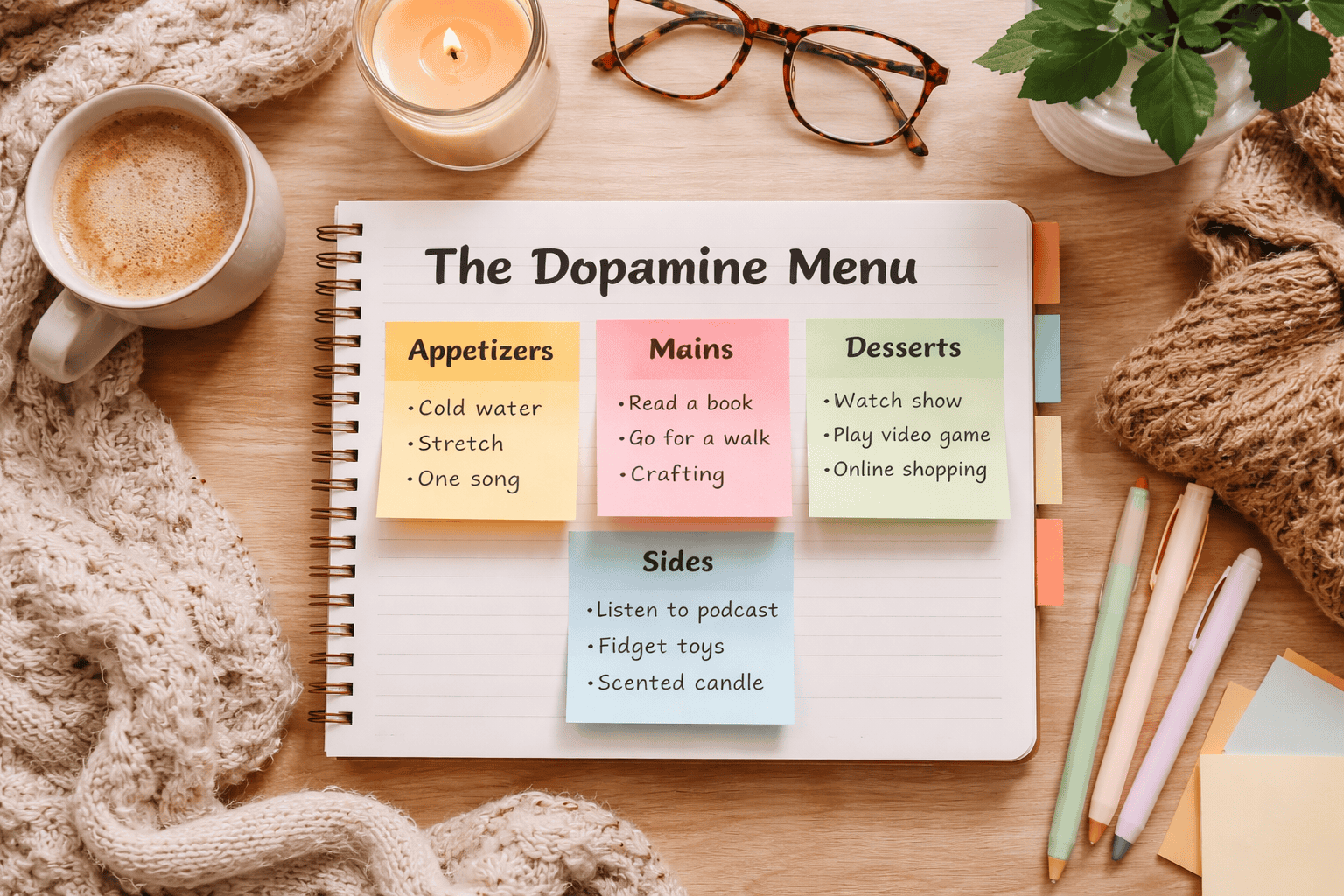
A dopamine menu is a short, personal list of everyday activities sorted into a few categories, like a menu at a restaurant. It has spread across TikTok, YouTube and ADHD blogs because it is visual, it is a little playful, and it asks you to choose rather than to push through.
The difference from ordinary self-discipline is timing. Without a plan, activities get chosen in the moment, usually by whatever you are craving. A menu is written when you are calm, so the question at 9pm stops being “what do I feel like doing?” and becomes “what is on my menu?”. That is a much smaller decision, and a smaller decision is easier to make on a tired evening.
- For adults, it is permission to start small. You do not need the perfect next step, just the next item on the list.
- For parents, a simple picture version gives a child something to choose from at the moments that usually turn into arguments, such as after school, before homework and at bedtime.

The Four Courses
Most dopamine menus use four sections. Each one has a different job.
Appetisers: Quick Ways to Start
Appetisers are short, low-effort actions for the moment you feel frozen. A large glass of cold water, a few star jumps, a five minute stretch, one favourite song. None of them is an achievement on its own. The point is movement, because starting something small often makes starting the next thing easier. The rule many people use is simple: appetiser first.
For children, appetisers can be a movement break or something sensory before homework or bed, like a few minutes on a mini trampoline or ten minutes of drawing.
Mains: The Things That Leave You Better Off
Mains are the activities you are glad you did afterwards: a walk, reading, a hobby, tidying one space, cooking a real meal. They take more time and more starting energy, which is why an appetiser often comes first. For children, mains might be LEGO, outdoor play, music practice or reading together.
Sides: Something Extra for Boring Tasks
Sides are what you pair with the jobs that still have to get done. A podcast while folding washing, a fidget while studying, a candle while answering emails, a friend on a video call while you both work. The side does not replace the task, it just makes it easier to stay with. Music during clean-up or a timer turned into a game works the same way for children.
Desserts: Enjoyable, and Best After Something Else
Desserts are the high-stimulation activities: scrolling, games, shows, online shopping. There is nothing wrong with them. The trouble comes when dessert is the first and only course and the whole evening disappears. Labelling them as dessert is a reminder to have them after something else, not instead of everything else. For children, dessert can be the screen time that comes after the homework, not before it.
How to Build Your Own Menu
Start with a blank page or the notes app on your phone. You are not designing a perfect routine, just a short list your future, tired self can follow.
- Keep it small. Three to five items per course is plenty. A long menu is just another list to feel bad about.
- Only list what is actually possible. Choose things you can do where you usually get stuck, on an ordinary tired evening, without buying anything.
- Put it where you get stuck. The bathroom mirror, beside your laptop, the fridge or your phone’s lock screen.
- Use the appetiser-first rule. When you notice yourself frozen or scrolling, do not argue with yourself. Pick one appetiser and do it.
- Expect to skip it sometimes. Some nights dessert will come first. That is normal. Start again the next evening rather than giving up on the menu.
This week, try just one thing: write three appetisers on a sticky note and put it where you usually get stuck. Five minutes of action can change the direction of an evening.
Using a Dopamine Menu With Children
For a child, keep everything simpler. A few options, pictures rather than words for younger children, and a spot where they can see it, like the fridge or their bedroom wall.
Menus are most useful at transitions: waking up, starting homework, getting ready for bed. Many children with ADHD struggle less with the task itself than with switching from one thing to another. Choosing the menu together, and letting your child pick from it, tends to go better than a list handed down to them.
It is worth being realistic. A menu will not stop every hard moment, and it is not a behaviour chart. It is one more way of giving a child a choice they can manage when the day is getting on top of them.

When a Menu Is Not Enough
A dopamine menu is a tool for the moment you get stuck. It is not a cure for anything, and it has limits.
- If you feel frozen for long stretches most days, or you cannot manage even an appetiser, the problem is bigger than a list of options.
- If ADHD is getting in the way of work, study, relationships or looking after yourself, talk to your GP. They can talk you through assessment and treatment, and refer you to a psychiatrist, psychologist or ADHD coach where that makes sense.
- For a child, if mornings, homework and after-school meltdowns stay hard whatever you try, your GP or paediatrician is the place to start.
- If you are feeling low, hopeless or overwhelmed, please talk to someone. Lifeline is on 13 11 14, any time, and in an emergency call 000.
A menu still has a place alongside all of that. It just should not be the whole plan.
Where Cognitive Pattern Reprogramming Fits
Cognitive Pattern Reprogramming draws on Clinical Hypnosis, Strategic Psychotherapy and Neuro-Linguistic Programming throughout each session. Clinical Hypnosis creates a highly focused state of attention, Strategic Psychotherapy identifies and works with unhelpful patterns, and NLP techniques interrupt those patterns and anchor more useful responses. It is delivered as guided audio. You stay aware and in control the whole way through, and it is designed to sit alongside anything else you already use.
In practice it is a 15 to 20 minute session you listen to at a quiet point in the day. Where a dopamine menu gives you something to do when you are stuck, Cognitive Pattern Reprogramming is aimed at the reaction underneath, the automatic pull towards the phone and the spiral of “I should be doing something” that often comes with it. How much it helps varies from person to person.
The sessions are created by Rob Edmonds, who holds a Diploma of Clinical Hypnosis and Strategic Psychotherapy and is a Neuro-Linguistic Programming Practitioner.
It does not diagnose or treat ADHD, and it does not replace medication, a psychologist, a paediatrician or anyone else you already see. It works alongside that care.
Questions People Ask
What is a dopamine menu?
A dopamine menu is a short personal list of activities, grouped like courses in a meal, that you write in advance so you have something to pick from when starting feels hard. It takes the deciding out of the moment, which is often the part that stalls people with ADHD.
Why do people with ADHD reach for their phone so often?
A phone hands out small, fast rewards for almost no effort, which makes it the easiest thing to reach for when starting anything else feels heavy. Researchers link ADHD with differences in how the brain handles reward and motivation, and dopamine is part of that picture, but the detail is still being worked out. The practical point is simpler: the phone is the nearest easy option, so a menu puts other easy options closer.
What goes in the appetiser section of a dopamine menu?
The appetiser section holds short, low-effort actions that take a minute or two: a glass of cold water, a stretch, one song, a step outside. Appetisers are not meant to sort out the whole evening. Their job is to get you moving so the next thing is easier to start.
What should go on the mains list?
The mains list holds the activities that leave you feeling better afterwards rather than emptier, such as a walk, reading, cooking a proper meal or a hobby you enjoy. Mains take more time, which is why an appetiser often comes first.
Are desserts allowed on a dopamine menu?
Desserts are allowed on a dopamine menu. Scrolling, games, shows and online shopping sit in the dessert section because they are enjoyable and easy to overdo. The idea is to have them after something else, not instead of everything else.
Can parents make a dopamine menu for a child with ADHD?
Parents can make a dopamine menu for a child with ADHD, and a picture version on the fridge often works better than words for younger children. Keep it to a few options, choose them together, and use it at transitions like after school or before homework rather than as a reward chart.
Is a dopamine menu a treatment for ADHD?
A dopamine menu is not a treatment for ADHD. It is a practical self-help tool for the moment you get stuck, and it sits alongside whatever care you or your child already have, including medication, a psychologist or an ADHD coach. If ADHD is getting in the way of work, school or relationships, a GP is the place to start.
How quickly does a dopamine menu help?
How quickly a dopamine menu helps varies from person to person. Some people find it useful the first evening they try it, and for others it takes a few weeks before reaching for it becomes a habit. Using it consistently matters more than getting the menu perfect.
Where should I keep my dopamine menu?
Keep your dopamine menu somewhere you will see it at the moment you usually get stuck: the bathroom mirror, beside your laptop, on the fridge or as your phone’s lock screen. The more often you see it, the more likely you are to use it.
Is Cognitive Pattern Reprogramming hypnosis?
Cognitive Pattern Reprogramming draws on Clinical Hypnosis, Strategic Psychotherapy and Neuro-Linguistic Programming throughout each session. Clinical Hypnosis creates a highly focused state of attention, Strategic Psychotherapy identifies and works with unhelpful patterns, and NLP techniques interrupt those patterns and anchor more useful responses. It is delivered as guided audio. You stay aware and in control the whole way through, and it is designed to sit alongside anything else you already use.
The Short Version
A dopamine menu is one of the simplest tools the ADHD community has picked up in years. Write a few options ahead of time, start with an appetiser, and keep dessert for later. It will not work every night, and it does not need to. The aim is a little more choice in the moments that usually run on autopilot.