
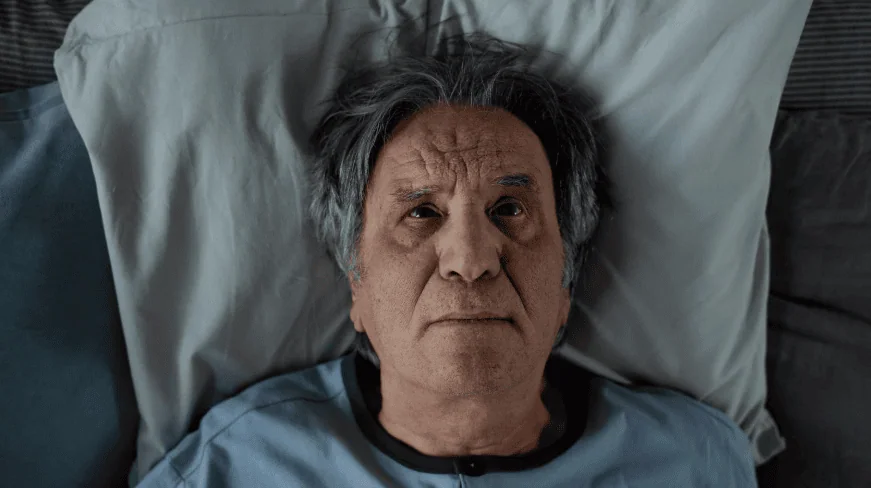
Most of us treat a bad night as a cost we pay the next day. Researchers have spent fifteen years asking a bigger question: do years of short or broken sleep cost something later, in the brain itself?
- The links are real and show up in very large studies.
- They are not yet proof of cause.
- Every source is linked at the bottom.
- This is general information, not medical advice. If you are worried about your memory or your sleep, start with your GP.
The short answer
- Short sleep in midlife is linked to higher dementia risk. In a 25 year UK study, people who regularly slept six hours or less in their fifties and sixties were about 30 per cent more likely to develop dementia (Sabia, 2021).
- Deep sleep appears to be when the brain clears waste, including proteins tied to Alzheimer's (Xie, 2013; Dagum, 2026).
- Sleep apnoea and insomnia are linked too, each with roughly a third higher risk (Ungvari, 2025).
- None of this proves poor sleep causes dementia. The link may run both ways.
If it is your mind that keeps you awake
For a lot of people, poor sleep is not about the bed. It is a head that will not switch off:
- replaying the day
- running through tomorrow
- waking at 3am and starting all over again
That is the part the MindShift Method is built for: 20 minute guided audio sessions, created by Rob Edmonds using Cognitive Pattern Reprogramming, designed to help you wind down, quieten the overthinking and support better sleep. Headphones on, press play. Nothing to practise, nothing to write down.
Results vary from person to person, and the sessions do not diagnose, treat, cure or prevent any condition, including dementia. They sit alongside your GP, not instead of them.
One email gives you one free session for 7 nights. No credit card. Do not listen while driving or operating machinery.
What is dementia?
- An umbrella term for conditions that affect memory, thinking, behaviour and everyday life, and get worse over time.
- Alzheimer's disease is the most common form.
- It is not a normal part of ageing, and only a doctor can diagnose it.
What the research found
- The six hour finding. Researchers followed 7,959 British adults for an average of 25 years. Regularly sleeping six hours or less at 50, 60 and 70 was linked to about a 30 per cent higher dementia risk, even after allowing for smoking, alcohol, exercise, heart health and mental health. Sleeping eight hours or more showed no link (Sabia, Nature Communications, 2021).
- The brain's night shift. In mice, the space between brain cells opens up by about 60 per cent during sleep, letting fluid wash out waste such as beta-amyloid. This is called the glymphatic system (Xie, Science, 2013). A 2026 trial in 39 people found results that fit the same picture; some of its authors work for the company that made the device (Dagum, 2026).
- One sleepless night shows up fast. In small studies, a night without sleep raised amyloid by about 5 per cent (Shokri-Kojori, 2018) and tau, the other Alzheimer's protein, by more than 50 per cent (Holth, 2019). Nobody has shown this lasts after a good night. The concern is years of it, not the odd rough night.
- Broken sleep counts too. A 2025 review of 39 studies linked sleep apnoea and insomnia to roughly a third higher dementia risk (Ungvari, 2025). In Australia, a 2026 Monash study of 2,795 people aged 40 to 70 found slightly weaker memory in people with untreated sleep apnoea; those being treated scored about the same as everyone else (Monash, 2026). The University of Sydney is now testing whether treating sleep problems lowers risk (University of Sydney).
Cause, or early sign?
Most of this research watches people over time rather than testing a treatment, so three things can all be true at once:
- Poor sleep may add to the build-up of amyloid and tau.
- Early brain changes may disturb sleep years before memory problems show.
- Something else, such as depression, heart disease or pain, may drive both.
- The 2024 Lancet Commission named 14 risk factors that together may account for about 45 per cent of dementia, including high blood pressure, hearing loss, inactivity and depression (Livingston, The Lancet, 2024).
- Sleep is not on that list, because the evidence is not yet strong enough to call it a cause.
- But it is strongly linked, it makes biological sense, and it is something most people can work on.
What Huberman and Walker say
Stanford neuroscientist Dr Andrew Huberman and Berkeley sleep scientist Dr Matthew Walker have both covered this on the Huberman Lab podcast:
- Walker: deep sleep is when the brain's cleaning system is most active, clearing beta-amyloid and tau (Huberman Lab with Matthew Walker).
- Huberman: his sleep toolkit keeps coming back to the basics. Morning light, a regular wake time, a cool dark room, and care with late caffeine (Huberman Lab, Sleep Toolkit).
Dementia in Australia, NZ, the UK and the US
| Country | Living with dementia | Looking ahead |
|---|---|---|
| Australia | About 439,000 (AIHW, 2025) | Over 1.1 million by 2065 |
| New Zealand | About 83,000 (Alzheimers NZ) | Close to 170,000 by 2050 |
| United Kingdom | About 982,000 (Alzheimer's Society) | 1.4 million by 2040 |
| United States | 7.4 million aged 65+ with Alzheimer's (Alzheimer's Association, 2026) | Nearly 13 million by 2050 |
- Each country counts a little differently, so treat these as estimates.
- Dementia Australia puts the 2026 Australian figure at 446,500 (Dementia Australia).
What you can do about your sleep
None of these prevents dementia, and none comes with a promise. They are the habits sleep researchers keep coming back to:
- Aim for seven to eight hours most nights, especially from your forties on.
- Keep a regular wake time, weekends included, and get daylight early.
- Keep the bedroom cool, dark and quiet.
- Go easy on late caffeine and alcohol. Alcohol tends to break up deep sleep.
- Get loud snoring or breathing pauses checked. Ask your GP about a sleep study. Sleep apnoea is common and treatable.
- Treat ongoing insomnia. CBT for insomnia (CBT-I) is the first recommended treatment in Australia; your GP can point you to it.
Worried about your memory, or someone close to you? See your GP. In Australia, the National Dementia Helpline is on 1800 100 500.
Want help with the winding-down part?
- The habits above look after the room and the routine.
- The MindShift sleep sessions are designed for the part they do not reach: the busy mind at bedtime and the 3am wake-up.
- Try one free for seven nights and see how it sits with you.
One email gives you one free session for 7 nights. No credit card.
Where the MindShift Method fits
The MindShift Method uses Cognitive Pattern Reprogramming, drawing on Clinical Hypnosis, Strategic Psychotherapy and Neuro-Linguistic Programming. It was created by Rob Edmonds, who holds a Diploma of Clinical Hypnosis and Strategic Psychotherapy and is a Certified Neuro-Linguistic Programming Practitioner.
- Clinical Hypnosis creates a highly focused state of attention.
- Strategic Psychotherapy identifies and works with unhelpful patterns, and is designed to help develop more useful ways of thinking, responding and behaving.
- Neuro-Linguistic Programming techniques may be used throughout to interrupt unhelpful patterns and anchor more useful responses.
- While listening, you remain aware and in control, able to hear what is being said and respond if you choose.
- The sessions are designed to be repeated, there is no fixed timeframe, and people respond differently.
- Do not listen while driving or operating machinery.
- It does not diagnose, treat, cure or prevent any condition, including dementia, sleep apnoea or insomnia.
- It sits alongside medical care rather than replacing it.
- It has not undergone an independent clinical trial as a complete branded method. See our method and evidence page.
- For the habits side, read what helps with better sleep.
One email gives you one free session for 7 nights. No credit card. After that, $29.95 a month or $299 a year unlocks the whole library. Cancel anytime.
References
- Sabia S, Fayosse A, Dumurgier J, et al. Association of sleep duration in middle and old age with incidence of dementia. Nature Communications, 2021;12:2289. doi.org/10.1038/s41467-021-22354-2. Plain-English summary: UCL News.
- Xie L, Kang H, Xu Q, et al. Sleep drives metabolite clearance from the adult brain. Science, 2013;342(6156):373-377. doi.org/10.1126/science.1241224.
- Dagum P, et al. The glymphatic system clears amyloid beta and tau from brain to plasma in humans. Nature Communications, 2026;17:715. doi.org/10.1038/s41467-026-68374-8.
- Shokri-Kojori E, Wang GJ, Wiers CE, et al. Beta-amyloid accumulation in the human brain after one night of sleep deprivation. PNAS, 2018;115(17):4483-4488. doi.org/10.1073/pnas.1721694115. Summary: NIH.
- Holth JK, Fritschi SK, Wang C, et al. The sleep-wake cycle regulates brain interstitial fluid tau in mice and CSF tau in humans. Science, 2019;363(6429):880-884. doi.org/10.1126/science.aav2546.
- Ungvari Z, et al. Sleep disorders increase the risk of dementia, Alzheimer's disease, and cognitive decline: a meta-analysis. GeroScience, 2025. doi.org/10.1007/s11357-025-01637-2.
- Livingston G, Huntley J, Liu KY, et al. Dementia prevention, intervention, and care: 2024 report of the Lancet standing Commission. The Lancet, 2024;404(10452):572-628. doi.org/10.1016/S0140-6736(24)01296-0.
- Huberman Lab. Guest Series: Dr Matthew Walker, Protocols to Improve Your Sleep. hubermanlab.com. See also: Dr Matt Walker: The Science and Practice of Perfecting Your Sleep.
- Huberman Lab, episode 84. Sleep Toolkit: Tools for Optimizing Sleep and Sleep-Wake Timing, August 2022. hubermanlab.com.
- Australian Institute of Health and Welfare. Dementia in Australia: prevalence of dementia. aihw.gov.au.
- Dementia Australia. New dementia prevalence data. dementia.org.au.
- RNZ. Families missing early dementia signs as projections soar, reporting Alzheimers New Zealand figures. rnz.co.nz.
- Alzheimer's Society. How many people have dementia in the UK? alzheimers.org.uk.
- Alzheimer's Association. 2026 Alzheimer's Disease Facts and Figures. alz.org.
- Monash University. Monash study links sleep apnoea with poor memory and greater dementia risk burden in midlife, 2026. monash.edu.
- University of Sydney. How better sleep could reduce dementia risk. sydney.edu.au.
Frequently Asked Questions
Lack of sleep has not been proven to cause dementia, but it is strongly linked to it. A 25 year UK study found people who regularly slept six hours or less in their fifties and sixties were about 30 per cent more likely to develop dementia later, and lab studies suggest sleep helps the brain clear proteins tied to Alzheimer's disease.
Dementia is an umbrella term for conditions that affect memory, thinking, behaviour and everyday functioning, and it gets worse over time. Alzheimer's disease is the most common form. Dementia is not a normal part of ageing, and only a doctor can diagnose it.
Most adults need seven to eight hours of sleep a night, and the strongest research link to dementia risk is with regularly sleeping six hours or less in midlife. Sleeping eight hours or more was not significantly linked to dementia risk in that study.
The glymphatic system is the brain's waste-clearing network, which uses the fluid around the brain to wash through brain tissue. Studies in mice found it works much faster during sleep, clearing proteins such as beta-amyloid, and newer human research points the same way.
Obstructive sleep apnoea is linked to a higher risk of dementia, about a third higher in a 2025 analysis of 39 studies. Sleep apnoea is common, often undiagnosed and treatable, so loud snoring, breathing pauses or daytime sleepiness are worth raising with a GP.
Poor sleep can be an early sign of dementia as well as a possible risk factor. The brain changes behind Alzheimer's begin years before memory symptoms and can disturb sleep, so researchers think the link probably runs both ways.
Whether melatonin or any other sleep aid suits you is a question for your GP or pharmacist, who know your health history and what else you take. This article does not recommend or rank sleep aids.
About 439,000 Australians were living with dementia in 2025, according to the Australian Institute of Health and Welfare, and Dementia Australia estimates 446,500 in 2026. The number is expected to rise to over 1.1 million by 2065.
No. The MindShift Method does not diagnose, treat, cure or prevent dementia or any other condition. Its guided audio sessions are designed to support winding down and sleep, and sit alongside medical care rather than replacing it.