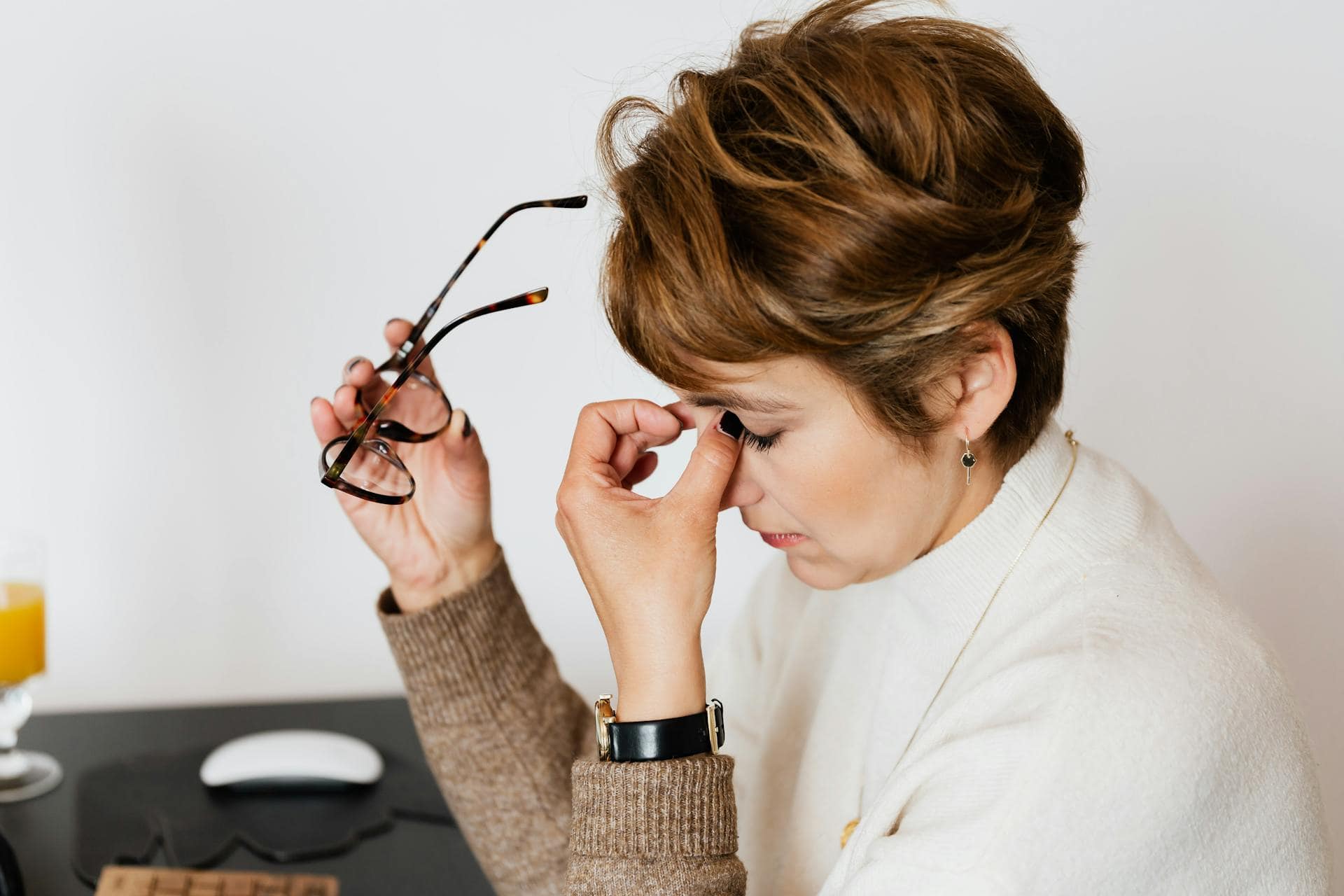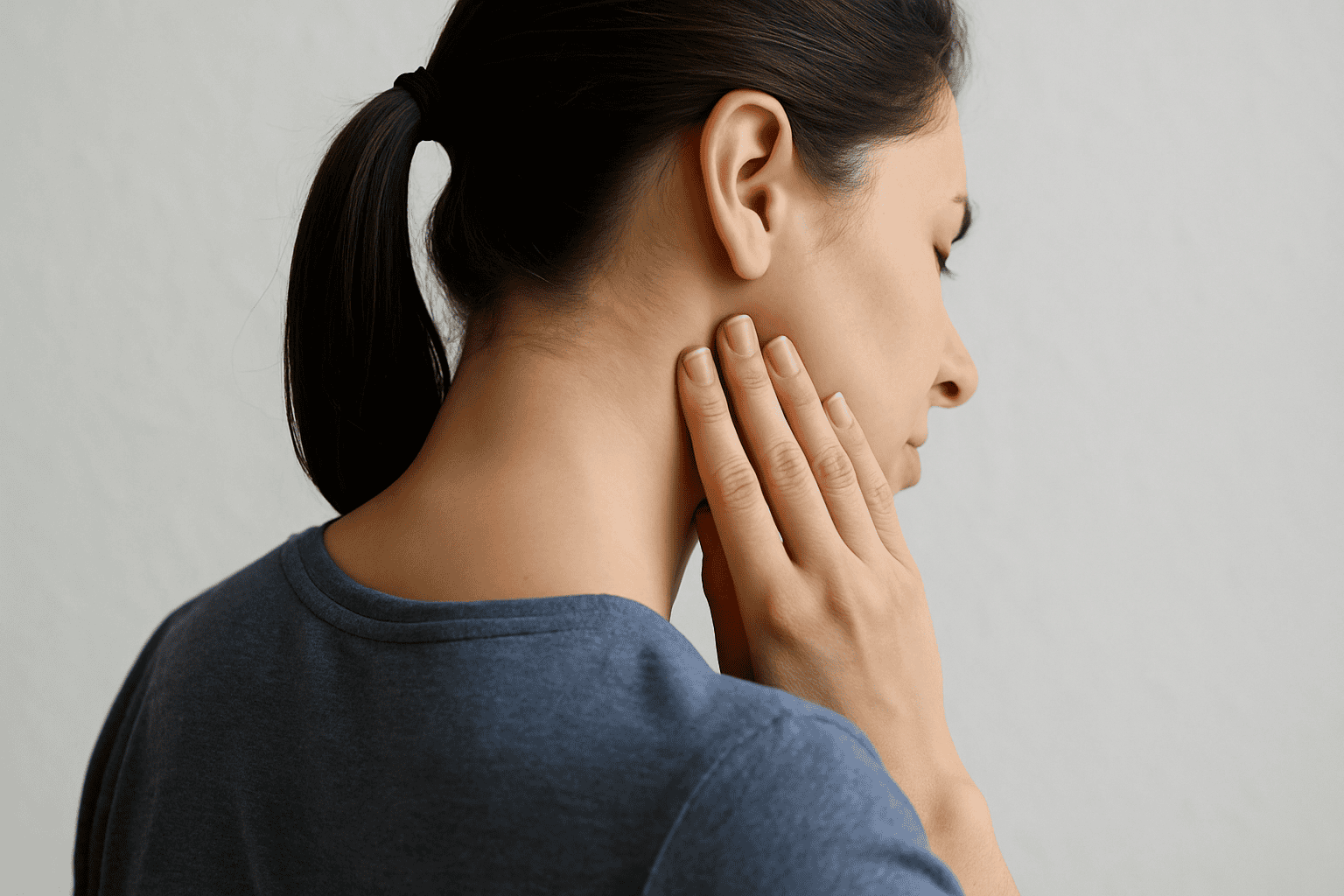

A sore jaw after a long day at a desk, or a stiff neck that arrives with it. The neck and the jaw are more connected than most people expect, and posture turns up alongside jaw pain often enough to be worth knowing about.
This page covers how the two are linked, what is worth changing at your desk, and where the stress side of it fits.
Table of Contents
What Is TMJ?
The term TMJ actually stands for temporomandibular joint, which is the hinge connecting your lower jaw (mandible) to your skull near your ears. You have two TMJs (one on each side), and you use them every time you talk, chew, or yawn. When people say “I have TMJ,” they usually mean they have a TMJ disorder – meaning something’s not right with that jaw joint or the muscles around it. TMJ disorders (often abbreviated as TMD) can happen to anyone and often start in early adulthood, but they can occur at any age.
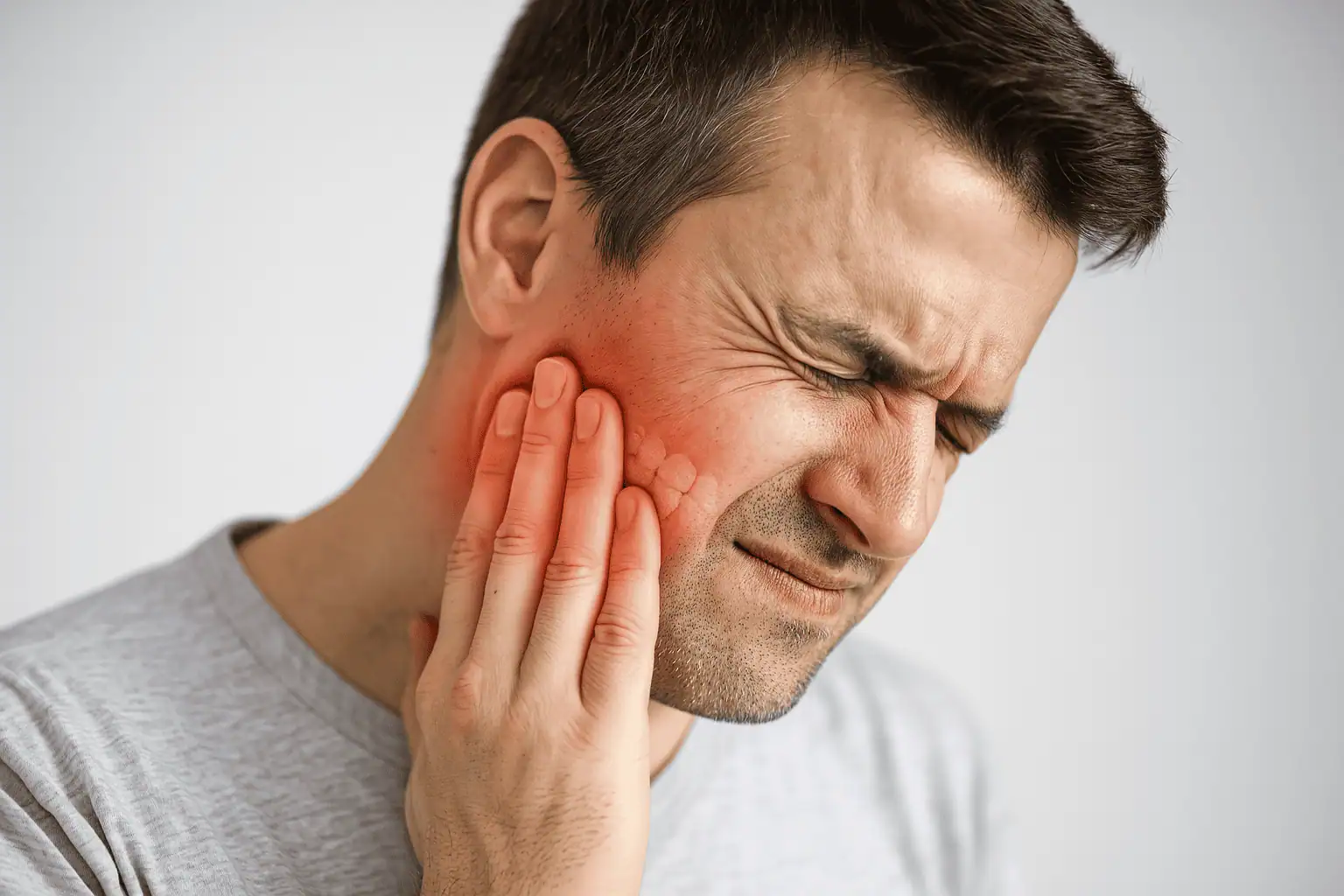
So, what does a TMJ problem feel like? Common symptoms include jaw pain or tenderness, difficulty opening your mouth fully, clicking or popping sounds in the joint, and even earaches or headaches. Some people also experience neck and shoulder pain because everything in this area is connected. For example, you might wake up with an aching jaw or find that your jaw clicks when you chew. These issues can range from mild (just an occasional annoyance) to severe (affecting eating or speaking).
Why do TMJ problems happen? There are lots of possible causes. Often it’s a mix of factors like teeth grinding (bruxism), jaw injuries, arthritis, or even chronic stress leading you to clench your jaw unconsciously. And as we’re about to explore poor posture is another sneaky contributor that many people overlook.
How Posture and Neck Alignment Affect TMJ
Now, you might be thinking, “What does my slouching have to do with my jaw?” It turns out TMJ and posture are closely linked, and poor posture can have a big impact on your jaw alignment. Picture your body as one connected system: if one part is out of line, it can throw other parts off. When we talk about posture here, we especially mean your head and neck alignment.
Think of your head like a bowling ball balancing on a stick (your spine). It weighs roughly 4 to 5 kilos, so if it sits forward by a few centimetres, your neck and shoulder muscles have to work overtime to hold it up. This common issue is called forward head posture – the classic “tech neck” you get from hunching over phones and laptops. When your head juts forward instead of sitting directly above your shoulders, several things happen:
Neck and shoulder strain: Your neck muscles tighten to support the forward weight, often leading to soreness or neck pain. Ever feel that burning tension after a day at the desk? That’s a sign of those muscles working too hard.
Jaw misalignment: Believe it or not, a forward head can actually pull your lower jaw (mandible) out of its natural alignment. The jaw might shift slightly backward or to the side as your head posture changes, putting strain on the TMJ.
Muscle tension in the jaw: The muscles that help move your jaw (for chewing, talking, etc.) attach to your skull and jawbone. If your head is forward and shoulders are rounded, those jaw muscles can get overstretched or overworked trying to find a comfortable position. This tension can make TMJ symptoms like pain or clicking worse.
Domino effect of pain: Poor posture can create a chain reaction. For instance, slouching with rounded shoulders often goes hand-in-hand with forward head posture, causing muscle imbalances in your upper back and chest. This imbalance travels upward, contributing to neck stiffness and jaw discomfort. Even your lower body posture (like a tilted pelvis when you slouch in a chair) changes the curve of your spine and can add stress up the chain to your neck and jaw.
In short, slouching isn’t just bad for your back – it can irritate your jaw joint too. Doctors and dentists have noticed that many patients with TMJ and posture issues often experience them together. The association shows up in the research too, though it is worth being careful with it: studies find forward head posture and TMJ pain turning up together, which is not the same as one causing the other. People with long-running neck pain are also more likely to have jaw symptoms. Both are reasons to look at posture, not proof that fixing it will fix your jaw.
So how do you know if your posture is affecting your jaw? Some clues include feeling tightness in your face or neck, getting more headaches or upper back pain when your TMJ flares up, or noticing your jaw pain is worse after a long day of looking down at a screen. If you suspect this might be you, don’t worry – there are ways to fix your posture and give your jaw some relief (we’ll get to those tips soon).
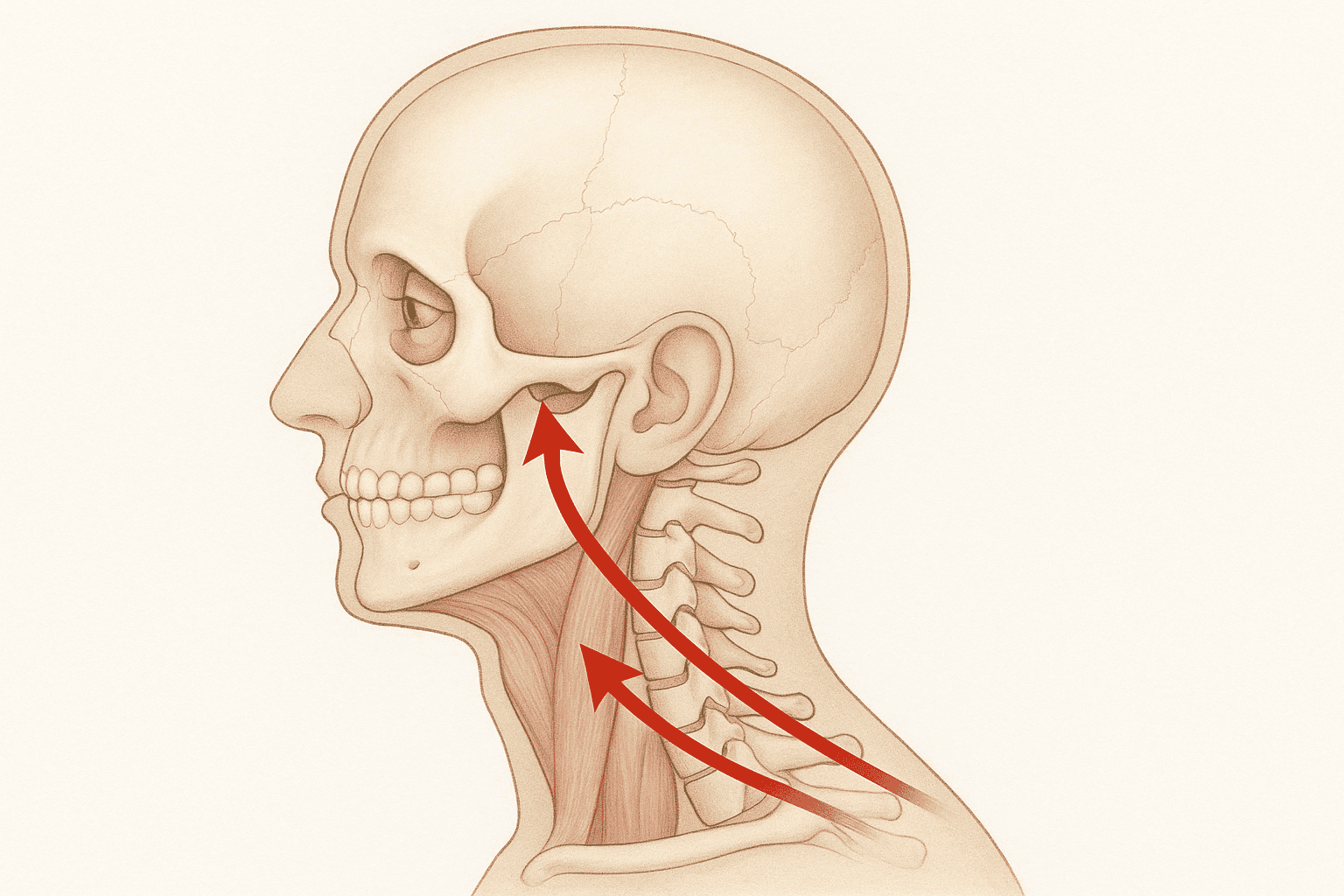
The Neck-Jaw Connection: Anatomy and Science in Simple Terms
Let’s talk a bit about why posture and TMJ are connected, in everyday language. It comes down to anatomy and a bit of physics. The key players here are bones, joints, and muscles:
Bones & Joints: Your skull sits atop your spine. The top of the spine (the cervical vertebrae in your neck) interfaces with the skull right beneath the ears. The jawbone (mandible) connects to the skull at the TMJ, just a tad in front of those ear openings. When your head’s position changes (like tilting forward or backward), the position of the jawbone in its joint can subtly shift too. Imagine a door hinge (jaw joint) that moves differently if the door frame (skull) is tilted – things won’t glide as smoothly.
Muscles & Ligaments: There are muscles from the jaw that extend down into the neck and vice versa. For example, a muscle called the sternocleidomastoid (SCM) runs from your chest/clavicle area up to just behind your jaw. If you have a tight SCM from poor posture, it can literally pull on the area near your jaw. Other neck muscles attach to the skull and jaw, so tension in the neck can transfer to the jaw and face. Conversely, if your jaw is in pain, you might unconsciously hold your head at an odd angle to avoid the pain, which can lead to neck strain. It’s all connected in a loop.
Nerves: The nerves that supply sensation to your jaw (like the trigeminal nerve) have connections in the neck and upper spine. How much the upper cervical spine contributes to jaw symptoms through those pathways is debated and not settled. Worth knowing the connection exists, not worth treating as established.
In simpler terms, think of the base of your skull, your jaw, and your upper neck as roommates in a small apartment – when one is out of whack, it affects the others. Poor posture (like a forward head position) shifts the balance in that cramped space. Muscles may spasm or become imbalanced, literally tugging the jaw joint slightly out of position. Over time, this can lead to irritation in the joint and inflammation, causing the pain, clicks, or difficulty chewing that characterize TMJ disorders.
On the flip side, improving your posture can often help reduce those TMJ aches. By keeping your head aligned over your spine and your shoulders back, you take pressure off the jaw. One physiotherapist mantra is “ears over shoulders” – meaning keep your ears lined up with your shoulders to maintain neutral head posture. This position gives your TMJ a break from constant strain.
And we have to mention one more factor here: stress. When you’re stressed or anxious, how does your posture look? Many of us tense up: shoulders creep toward the ears, neck stiffens, jaw clenches tight. Chronic stress often leads to muscle tension. If you carry stress in your neck and shoulders, you’re more likely to clench your jaw or grind your teeth, even without realizing it. Slumped posture can amplify this tension, creating a vicious cycle of tight muscles and joint strain. This is why a holistic approach to TMJ pain considers not just the physical alignment of your body, but also your emotional stress levels and habits – which is the part the next section is about.

Tips to Improve Posture and Relieve Jaw Pain
The good news is that posture habits can be changed – and even small adjustments can make a big difference for your jaw and your overall comfort. By improving your head and neck alignment, you can reduce unnecessary pressure on your TMJs. Here are some simple, easy-to-follow tips to help both your posture and your jaw:
Sit (and Stand) Tall: Whether you’re at your desk or standing in line, think about stacking your ears over your shoulders. Try to keep your chin parallel to the ground (not jutting out forward or tipped too far down). A little trick: imagine a string pulling the crown of your head up toward the ceiling – this elongates your spine and naturally brings your head back in line.
Ergonomic Setup: If you work at a computer, adjust your setup. The top of your monitor should be at eye level so you’re not craning your neck down. Use a chair that supports your lower back. Keep your feet flat on the floor. When everything is at the right height, you won’t be tempted to slouch. Proper ergonomics keeps your body in a neutral position, reducing strain on your neck and jaw.
Take Frequent Breaks: Don’t stay in one position for too long. Every 30 minutes or so, stand up and stretch. Roll your shoulders, gently turn your neck side to side, maybe do a quick chest-opening stretch (like clasping your hands behind your back and lifting them a bit). These mini-breaks reset your posture and prevent stiffness. Plus, it’s a nice mental break too.
Hold Devices Higher: If you’re constantly looking down at your phone or tablet, try lifting it up to eye level (or nearly eye level) whenever possible. This prevents that forward-head slump. Similarly, if reading a book or texting, prop your elbows on something to raise the material closer to your face.
Strengthen and Stretch: Incorporate some quick exercises into your day. For example, chin tucks are great for combating forward head posture – gently draw your chin straight back (giving yourself a “double chin” look), hold for a few seconds, and release. This strengthens deep neck muscles that keep the head aligned. You can also stretch your chest muscles (doorway stretches work well) and strengthen your upper back (try squeezing your shoulder blades together) to help undo rounded shoulders. Even a few minutes a day can help balance muscle tension.
Jaw Relaxation Techniques: While working on your posture, don’t forget your jaw wants relaxation too. Make a habit of checking in with your jaw – is it clenched tight? If so, consciously drop your jaw slightly so your teeth aren’t touching and let your tongue rest gently behind your top teeth. This is the jaw’s “happy place” or resting position. You can also gently massage the jaw muscles (the spots just below your ears and along your cheeks) to ease tension.
By practising these habits, you are re-teaching your body where neutral sits. It might feel awkward at first (especially keeping that chin tucked in or shoulders back), but over time it gets easier. Many people find that as their posture improves, they experience fewer headaches, less neck stiffness, and notably, reduced jaw pain. It’s all about consistency and making small changes part of your daily routine.
Where Cognitive Pattern Reprogramming Fits
Posture work and jaw exercises deal with the mechanics. They do not touch the reason a lot of people are clenching in the first place, which for many is simply the load they are carrying.
Cognitive Pattern Reprogramming is not hypnosis. It uses a structured psychological framework aimed at the automatic response, delivered as guided audio. You stay aware and in control the whole way through, and it is designed to sit alongside anything else you already use, including your physio, your dentist and your posture habits.
For jaw tension the target is the stress response the clenching is attached to. It is drug-free, there is nothing to wear and nothing to swallow, and you do it at home with headphones for 15 to 20 minutes a day. Some people find their jaw is easier in the mornings. Some do not. Results vary, and we would rather say so.
It does not correct your posture, fix a bite problem, or treat a damaged joint. Those stay physiotherapy, dental and medical jobs.
This Will Not Suit Everyone
It tends to suit people who:
- clench or grind in response to stress and recognise that in themselves
- have had the jaw and the neck looked at and want to work on the trigger too
- are willing to listen daily for a stretch rather than hunting for a one-off fix
Look elsewhere first if:
- your jaw locks, catches painfully, or will not open fully. A dentist, now.
- the neck pain is sharp, radiating into an arm, or came with numbness or weakness. That is a GP appointment today, not a posture problem.
- you have a diagnosed joint, disc or autoimmune condition affecting the jaw or neck.
- the pain started after an injury or a fall.
When to See Someone
Book an appointment if any of this sounds like you:
- jaw or neck pain that has been there more than a couple of weeks
- a jaw that locks, catches, or will not open fully
- trouble chewing or speaking clearly
- teeth that are visibly worn, chipped or cracked
- numbness, tingling or weakness in an arm or hand
- pain that came on suddenly and severely. That is urgent.
Nothing on this page replaces medical, dental or physiotherapy care. The audio programs are designed to work alongside it. If you are already seeing someone about your jaw or your neck, keep seeing them.
FAQs About TMJ and Posture
Can TMJ pain go away on its own?
Mild jaw pain often settles, particularly when it was set off by a stretch of stress or a few bad weeks at a desk. Pain that has been there more than a couple of weeks, or that is getting worse, is worth having looked at by a dentist, GP or physiotherapist rather than waiting out.
Can poor posture really cause TMJ pain?
Forward head posture and jaw pain turn up together often enough that posture is worth looking at, and the research finds the same association. That is not the same as one causing the other, and posture is rarely the whole story. Treat it as one thing you can change rather than the explanation.
What are the signs of a TMJ disorder?
The usual signs are jaw pain or tenderness, clicking or popping, a jaw that will not open as far as it used to, earache, headaches, and tension through the neck and shoulders. A dentist can usually tell you whether that is what you are dealing with.
Does stress make it worse?
Stress is one of the most commonly reported triggers for clenching and grinding, and clenching loads the joint. Plenty of people notice their jaw is worse in a hard stretch. That does not mean the pain is imaginary or that stress is the only cause.
How do I improve my posture to take pressure off my jaw?
Keep your head stacked over your shoulders rather than jutting forward, get your screen up to eye level, and break up long stretches of sitting. Chin tucks help with the deep neck muscles. A physiotherapist can give you something specific to your body, which beats general advice.
Where does Cognitive Pattern Reprogramming come into it?
Cognitive Pattern Reprogramming is guided audio built on a structured psychological framework. It works on the automatic stress response that clenching is often attached to, rather than on the joint or the posture. You stay aware and in control throughout. It is not hypnosis, and it is designed to sit alongside dental, medical and physiotherapy care rather than replace it.
Can I use it alongside a night guard or physio?
Yes, and they do different jobs. A guard protects the teeth, physio works the muscle and the joint, posture work takes load off the neck, and the audio works on the stress pattern. None of them replaces professional care and none cancels the others out.
Is it safe?
The audio programs are non-invasive and drug-free, and you stay aware and in control throughout. We are not in a position to clear anyone medically. If you are pregnant, breastfeeding, or managing any health condition, check with your doctor first, and do not listen while driving.
Your jaw and your neck share the same small piece of real estate, so it is worth treating them as one problem rather than two. Get the setup at your desk right, get the joint looked at if it has been sore for a while, and work on the stress pattern underneath at the same time.