
Jaw pain, a jaw that clicks, headaches that sit in the temples, an ache that reaches the ear or the neck. TMJ disorder is diagnosed in women far more often than in men, and a lot of women go a long time being told it is a dental problem, a migraine, or nothing much.
This page covers what the disorder actually is, what is known and not known about why it skews female, what each of the usual treatments does, and where the stress side fits.
Table of Contents
What TMJ Disorder Is

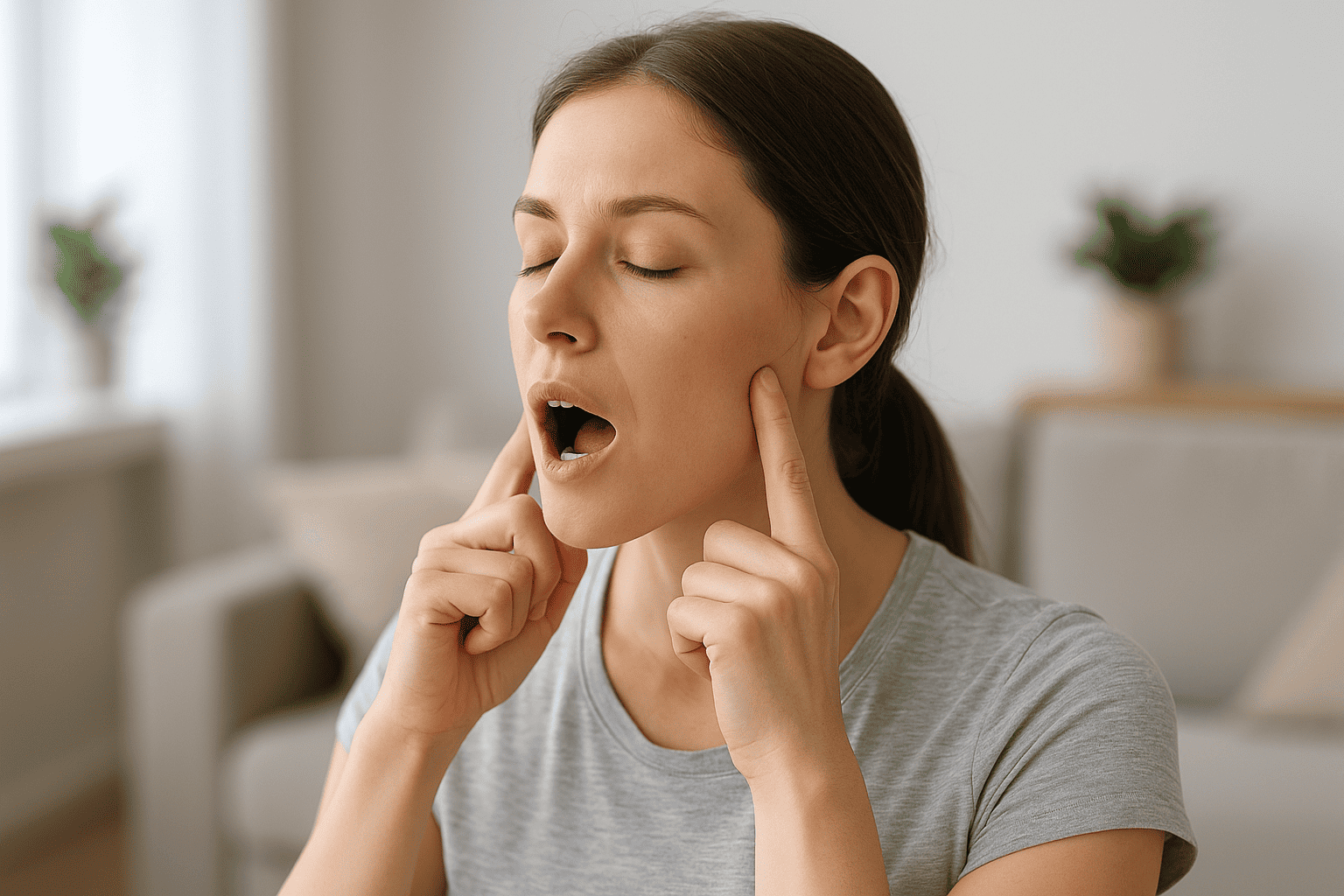
The temporomandibular joint is the hinge connecting your jaw to your skull, just in front of each ear. TMJ disorder, or TMD, is the umbrella term for problems with that joint and the muscles around it. It is common and it is usually manageable.
What it tends to look like:
- clicking, popping or catching when you open your mouth
- a jaw that feels stiff or tired, worst on waking
- headaches across the temples or behind the eyes
- pain when chewing, or after talking for a while
- aching that reaches the ear, the neck or the shoulder
- teeth that look worn or feel sensitive, if grinding is part of it
A dentist is usually the person who puts a name to it, and worth seeing early rather than waiting to see whether it settles.
Why It Turns Up More Often in Women

The sex difference in TMD is well documented. The explanation is not, and it is worth being straight about that rather than picking one and stating it as fact.
- Hormones. Oestrogen receptors have been found in the jaw joint, and some women notice their symptoms track with their cycle, pregnancy or menopause. How much of the difference that accounts for is still being worked out.
- Stress load. Clenching is one of the ways a body carries pressure, and it does not ask permission first. That applies to anyone, and it is often reported alongside a stretch where a lot is being held together.
- Autoimmune and joint conditions. Several of these are more common in women and some affect the jaw joint directly. That is a GP question, not a dental one.
- How pain gets heard. Women report facial pain more often and are also more often told it is stress. Both things can be true, and the second is a reason to keep asking rather than to stop.
How Stress Reaches the Jaw

Clenching and grinding are involuntary. Most people who do it overnight have no idea until someone tells them or a dentist spots the wear. That is why willpower is no use against it: by the time it is happening you are asleep.
Hold the jaw muscles under load for hours and they behave like any other overworked muscle. They get tight, they ache, and the temporalis runs up over your temple, which is why the pain so often reads as a headache. Broken sleep and the ache then feed each other.
You can be perfectly unbothered on the surface and still be carrying enough that your jaw does the work at 2am.
What Helps, and What Each Thing Does
A splint or night guard
A custom splint from your dentist holds the jaw in a better position and takes the damage instead of your teeth. Many people find their morning pain eases with one. It does not stop the clenching, and it is not meant to.
Jaw physiotherapy
Stretching, massage and guided movement can ease stiffness and improve how far the jaw opens. A physiotherapist who works with TMJ can show you what to do at home in a few minutes.
Medication
Anti-inflammatories or a short course of muscle relaxant, prescribed by your doctor, can get you through a flare-up. They are not a plan for something happening most nights.
Botox
Botox into the jaw muscle is used to reduce how hard it can contract. It is a medical procedure with its own considerations and it wears off, so it is a conversation with a doctor rather than something to decide from an article.
Everyday stress management
Breathing work, a proper wind-down, less caffeine late in the day. Slow, unglamorous, and the only thing here that costs nothing.
Cognitive Pattern Reprogramming
Daily guided audio aimed at the stress response rather than at the joint. Next section.
Where Cognitive Pattern Reprogramming Fits
Cognitive Pattern Reprogramming draws on Clinical Hypnosis, Strategic Psychotherapy and Neuro-Linguistic Programming throughout each session. Clinical Hypnosis creates a highly focused state of attention, Strategic Psychotherapy identifies and works with unhelpful patterns, and NLP techniques interrupt those patterns and anchor more useful responses. It is delivered as guided audio. You stay aware and in control the whole way through, and it is designed to sit alongside anything else you already use, including your splint, your physio and your dentist.
The thing it works on is the stress response the clenching is attached to, which is the one part of this a splint cannot reach. It is drug-free, there is nothing to swallow, and you do it at home with headphones for 15 to 20 minutes a day. Some women find their jaw is easier in the mornings. Some do not. Results vary, and we would rather say so.
It does not fix a damaged joint, an uneven bite, arthritis or a worn tooth. Those stay medical and dental jobs.
One session free for 7 nights. No credit card. $29.95/month unlocks all 50+ sessions. Cancel anytime.
This Will Not Suit Everyone
It tends to suit women who:
- clench or grind in response to stress and recognise that in themselves
- have had the dental and medical side looked at and want to work on the trigger too
- are willing to listen daily for a stretch rather than hunting for a one-off fix
Look elsewhere first if:
- your jaw locks, catches painfully, or will not open fully. A dentist, now.
- the pain is sharp, getting worse, or came on suddenly.
- you have a diagnosed joint or autoimmune condition affecting the jaw.
- the symptoms started with a new medication or a change in your health.
When to See a Dentist or Doctor
Book an appointment if any of this sounds like you:
- jaw pain that has been there more than a couple of weeks
- a jaw that locks, catches, or will not open fully
- trouble chewing or speaking clearly
- headaches most mornings, or headaches that are getting worse
- teeth that are visibly worn, chipped or cracked
- swelling, fever, or pain that came on suddenly and severely. That is urgent.
Nothing on this page replaces medical, dental or psychological care. The audio programs are designed to work alongside it. If you are already seeing someone about your jaw, keep seeing them.
FAQs About TMJ Disorder in Women
Why do more women get TMJ disorder than men?
TMJ disorder is diagnosed in women far more often than in men, and the reasons are not fully settled. Oestrogen's effect on the joint, differences in how pain is reported and treated, and the stress load many women carry are all put forward, and the research is still working it out. What is clear is that it is common and it is not imagined.
Can stress cause TMJ symptoms?
Stress is one of the most commonly reported triggers for clenching and grinding, and clenching loads the jaw joint. That does not mean every case of jaw pain is stress, and it does not mean the pain is in your head. A dentist or GP can check for the structural causes, and the stress side is worth working on either way.
What are the early signs of TMJ disorder?
The usual early signs are a jaw that clicks or pops, tension headaches, stiffness on waking, and pain when chewing or talking for a while. Aching that spreads into the ear, temple or neck is common too. If any of that has been going on for more than a couple of weeks, get it looked at.
Do hormones really play a part?
Possibly. Oestrogen receptors have been found in the jaw joint and some women notice their symptoms track with their cycle, pregnancy or menopause. The research is not settled on how much of the difference that explains, so treat it as one plausible factor rather than the answer. If your symptoms follow a pattern, it is worth mentioning to your GP.
How does Cognitive Pattern Reprogramming fit in?
Cognitive Pattern Reprogramming is guided audio built on a structured psychological framework. It works on the automatic stress response that clenching is often attached to, rather than on the joint. You stay aware and in control throughout. It draws on Clinical Hypnosis, Strategic Psychotherapy and NLP, and it is designed to sit alongside dental and medical care rather than replace it.
Is it safe during pregnancy, breastfeeding or menopause?
The audio programs are non-invasive and drug-free, and you stay aware and in control throughout. We are not in a position to clear anyone medically, though. If you are pregnant, breastfeeding, or managing any health condition, check with your doctor or midwife first. Do not listen while driving or operating machinery.
How long before I notice anything?
That varies, and nobody can give you an honest number. Some women say their jaw feels looser in the mornings fairly early on, others take longer, and some find it does not help them much. The programs are built around listening daily, because repetition is what settles a pattern.
Can I use it alongside a splint, physio or Botox?
Yes. The audio programs are designed to work alongside whatever your dentist or doctor already has you doing. A splint protects the teeth, physio works the muscle and joint, and the audio works on the stress pattern. None of them replaces professional care, and none of them cancels the others out.
Jaw pain that keeps coming back is worth taking to a dentist rather than living with, and a lot of women have been living with it a long time. Get the joint and the teeth assessed, use whatever protects them, and work on the stress pattern underneath at the same time.
There is more on this in the Mind and Body Reset pathway, which groups the MindShift sessions written for it.