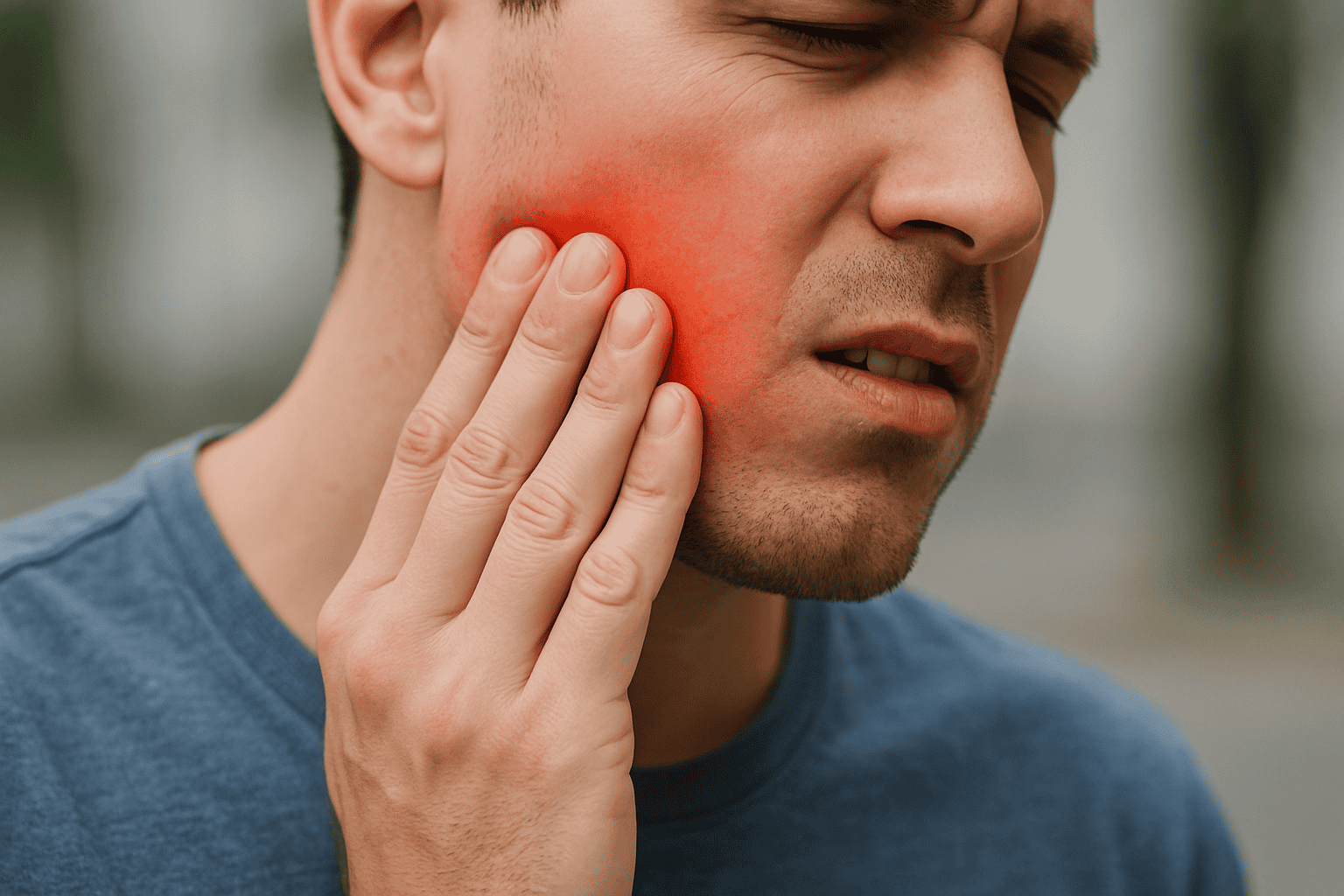

Waking with a sore jaw, a headache across the temples, or a jaw that clicks when you open wide is a common pairing with teeth grinding. Grinding, or bruxism, is the clenching or grinding of the teeth, usually while asleep and usually without the person knowing. The temporomandibular joint, the hinge just in front of each ear, takes the load.
The two often turn up together, which is why a dentist who finds one will look for the other. This page covers how to tell whether grinding is part of your jaw pain, what the signs look like, where stress comes into it, and when to stop guessing and get it looked at.
Table of Contents
Bruxism and TMJ Disorder, Briefly
Bruxism is clenching or grinding the teeth. It happens in sleep, and it happens awake, usually while concentrating or under pressure. Occasional grinding is common and not much of a problem. Night after night for months is a different thing, and it can wear enamel, flatten or chip teeth and leave the jaw muscles sore.
TMJ disorder is a label for problems with the jaw joint and the muscles that work it. It shows up as clicking or popping, facial pain, stiffness, restricted opening or pain while chewing. It has plenty of possible causes, of which grinding is one.
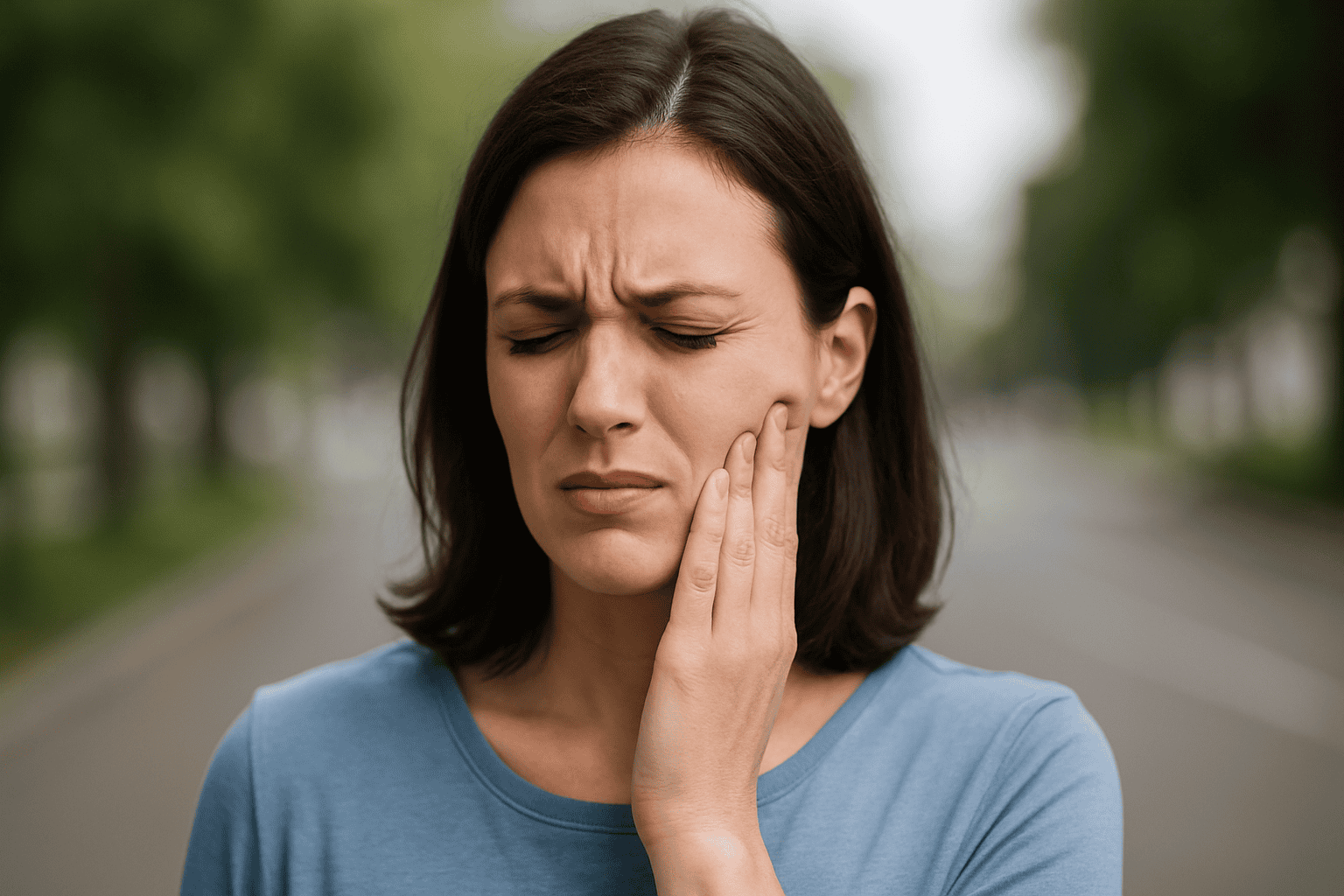
So the honest version is that the two are associated rather than one being the proven cause of the other. If you are grinding and your jaw hurts, grinding is a reasonable suspect. It is not the only one, and a dentist can tell you a great deal more in twenty minutes than an article can.
How Grinding Loads the Joint
The jaw muscles are built for short bursts: talking, chewing, a yawn. Grinding asks them to work for hours at a stretch, at night, with no rest between. Three things tend to follow from that.
- Muscle fatigue and soreness. The most common and the least serious. It is why the ache is usually worst on waking and eases through the morning.
- Irritation around the joint. Sustained load can inflame the tissues around the joint, which is when opening wide starts to hurt rather than just feel tight.
- Wear on the disc inside the joint. A small pad of cartilage cushions the joint. Long-term load is one of the things associated with it wearing or slipping out of position, which is the sort of thing an imaging scan is for.
That last one is the reason to take a grinding habit seriously rather than the reason to be frightened of it. Most people never get anywhere near it. Early is simply easier than late.
Signs Your Jaw Pain Is Grinding Related

Grinding is hard to catch in the act. These are the signs that point at it.
- A sore or stiff jaw first thing. Worst on waking, easing through the morning, is the pattern that most suggests something happening overnight.
- Morning headaches. Typically across the temples, where the muscle that does most of the clenching sits.
- Clicking, popping or a jaw that catches. Worth mentioning to a dentist, particularly if it is new or painful.
- Teeth that look flat, chipped, or have become sensitive. This is the one you cannot see properly yourself and a dentist can.
- Neck and shoulder tightness. The jaw does not work on its own, and tension in one often turns up in the other.
- Waking up tense, or sleep that does not leave you rested. Often the first thing people notice, and the last thing they connect to their jaw.
Healthline has a useful plain-English rundown of what else can cause a tight jaw, which is worth a read before settling on one explanation.
Where Stress Comes Into It
Stress and anxiety are the most commonly named triggers for grinding, and the association is well described. The mechanism is less settled than most articles suggest, so it is worth being plain: a jaw held tight all day gets sore, and people under pressure tend to hold their jaw tight. That is enough to be going on with without claiming more.
The awkward part is that clenching is largely automatic. It is not a decision, so deciding to stop does not work, in the same way that deciding not to be startled does not work. Most people only notice they are doing it once something hurts.
That is why the stress half of this is usually the half that gets skipped. A splint is a thing you can put in, physio is an appointment you can book, and "do something about the stress" sounds like advice rather than a plan. It is worth having a plan for it.
Where Cognitive Pattern Reprogramming Fits

Cognitive Pattern Reprogramming draws on Clinical Hypnosis, Strategic Psychotherapy and Neuro-Linguistic Programming throughout each session. Clinical Hypnosis creates a highly focused state of attention, Strategic Psychotherapy identifies and works with unhelpful patterns, and NLP techniques interrupt those patterns and anchor more useful responses. It is delivered as guided audio. You stay aware and in control the whole way through, and it is designed to work alongside professional care rather than instead of it, including your dentist, your splint and your physio.
For grinding, the target is the stress response the clenching is attached to, which is the part a splint is not aimed at. It is drug-free, there is nothing to wear and nothing to swallow, and you do it at home with headphones for 15 to 20 minutes a day. Some people find their jaw is easier in the mornings. Some do not. Results vary, and we would rather say so.
It does not repair worn enamel, correct a bite, treat a damaged disc or fix a cracked tooth. Those stay dental and medical jobs. The University of Minnesota has a readable summary of how mind-body approaches are thought to work, including what the evidence does and does not show.
One session free for 7 nights. No credit card. $29.95/month unlocks all 50+ sessions. Cancel anytime.
When to See Someone About It
Jaw pain gets put up with for months. These are the ones worth booking for instead of waiting out.
- Pain that has lasted more than a couple of weeks, or that is getting worse.
- A jaw that locks, catches, or will not open or close properly.
- Teeth that are visibly worn, chipped, cracked or newly sensitive.
- Trouble chewing or speaking.
- Headaches most mornings.
- Sleep that is being broken by it.
A dentist is the usual first stop, because they can see the wear, check the bite and the joint, and fit a splint if you need one. A GP is a reasonable alternative if you are not sure the jaw is the whole story, or if the sleep problem is the bigger half. A physiotherapist is useful once you know what you are dealing with.
If pain or poor sleep is wearing you down more generally, that is worth raising with your GP too. Ongoing pain takes a toll on mood and it is a normal thing to get help with. In Australia you can call Lifeline on 13 11 14 any time, and in an emergency call 000.
FAQs About Bruxism and TMJ Pain
What causes bruxism?
Usually more than one thing. Stress and anxiety are the most commonly cited, along with poor sleep, an uneven bite, some medications, and stimulants like caffeine, alcohol and nicotine. A dentist is the right person to work out what is driving yours.
Can bruxism cause TMJ disorder?
Grinding loads the jaw joint and the muscles around it, and the two turn up together often enough that dentists look for one when they find the other. That is not the same as saying grinding always causes it. Plenty of people grind without joint trouble, and plenty have joint trouble without grinding.
How do I know if I grind my teeth at night?
You usually do not, which is the awkward part. The clues are a sore jaw or a headache on waking, teeth that look flattened or have become sensitive, and a partner who can hear it. A dentist can see the wear pattern, which is the only reliable check.
Should I stop wearing my mouthguard?
No, not off the back of anything on this page. A splint or mouthguard protects your teeth from the force of grinding, and whether you keep wearing it is a decision for the dentist who fitted it. Everything here is meant to sit alongside it.
Will a mouthguard stop the pain?
It protects the teeth, which is the job it is designed for. It does not stop the grinding itself, so a sore jaw can carry on while you wear one. That is not a reason to stop wearing it, it is a reason to look at what is setting the grinding off as well.
Where does Cognitive Pattern Reprogramming fit?
Cognitive Pattern Reprogramming is guided audio aimed at the stress response that clenching and grinding are often attached to. It draws on Clinical Hypnosis, Strategic Psychotherapy and NLP, it is not a treatment for the joint itself, and it is designed to sit alongside your dentist, your GP and your physio. Results vary.
Can I use it alongside a splint or physio?
Yes. It is aimed at a different part of the problem, so it does not clash with dental or physical treatment. Keep seeing whoever you are already seeing.
Is TMJ pain permanent?
Not necessarily. Some people find their symptoms settle with a mix of dental care, physio, load management and stress work. Others get flare-ups on and off. It depends on what is driving it, which is why getting it looked at is worth more than guessing.
When should I see a dentist rather than wait?
When the pain has lasted more than a couple of weeks, when the jaw locks or catches, when teeth are visibly worn or newly sensitive, or when it is interfering with eating or sleep.
Final Thoughts
If you are grinding and your jaw hurts, the two are probably connected, and the useful work splits in two. Protect the teeth and get the joint checked, which is the dentist’s half. Then do something about what is setting the grinding off, which is yours. Neither half does the other one’s job, and the second is the one people leave out.
If this is something you live with, have a look at the Mind and Body Reset pathway: 15 to 20 minute guided audio sessions designed to sit alongside any other support you have.